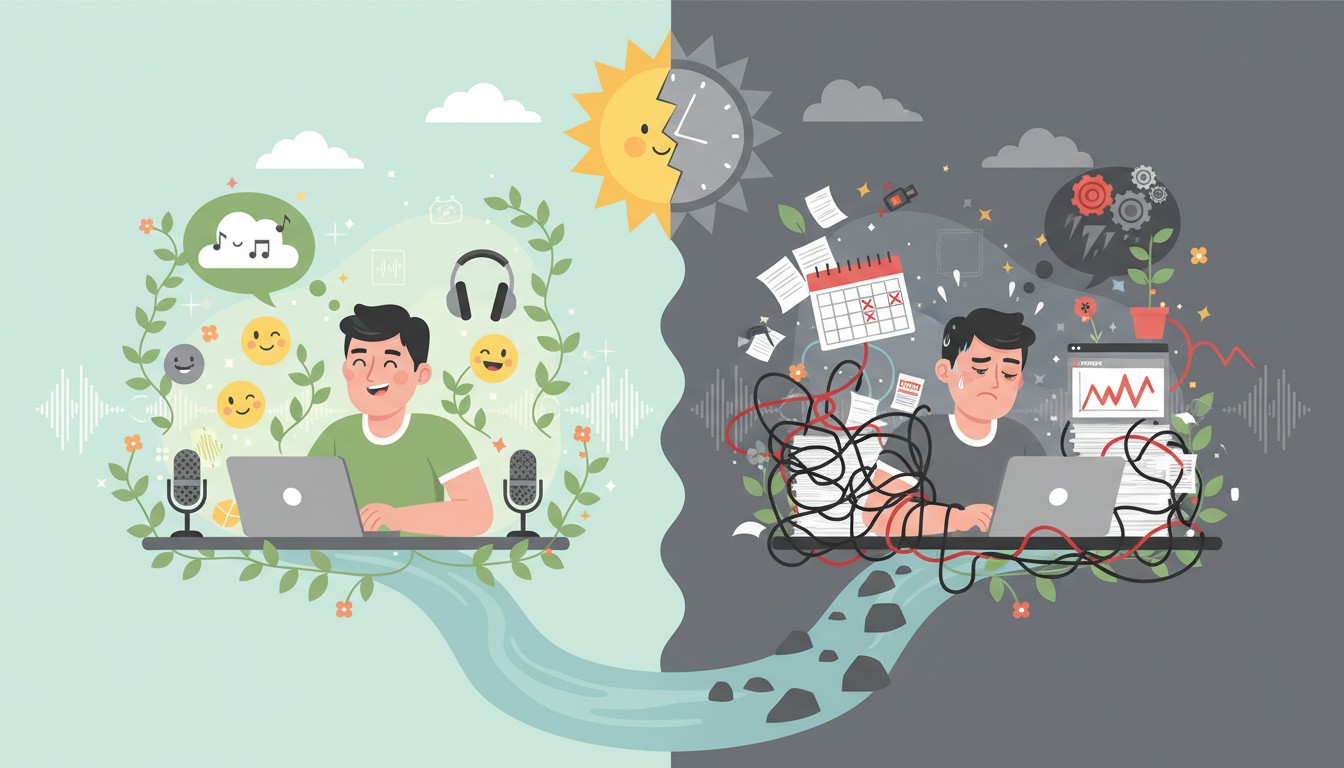
The transition from hobby to hustle is where podcast dreams go to die. Research from creator economy studies reveals that 90% of content creators experience burnout, with podcasters showing the highest rates of “creative exhaustion” at 67%—higher even than YouTubers or Instagram influencers. The moment you attach a dollar sign to your passion, the psychological architecture shifts: release schedules become deadlines, listener feedback becomes performance reviews, and your authentic voice becomes a brand asset to be optimized.
This burnout is uniquely podcast-shaped. Unlike visual creators who can batch-produce content, podcasters face the weekly tyranny of the feed—an unbroken chain of episodes that stops for nothing: illness, family crises, creative droughts. The medium’s intimate nature, once a source of joy, becomes a source of pressure when listeners feel entitled to your time, your stories, your emotional labor. The very authenticity that built your audience becomes a performance you can no longer sustain.
The Psychological Tipping Point: When Passion Becomes Pressure
The shift from hobby to business isn’t gradual—it’s a discrete moment when the creative calculus changes. A study on creative burnout identifies this as the “monetization inflection point,” where creators shift from intrinsic motivation (joy of creation) to extrinsic motivation (financial survival). For podcasters, this typically occurs around episode 25-30, when the initial creative rush fades and the reality of endless production sets in.
The symptoms are immediate and physical: recording sessions feel like pulling teeth, editing takes twice as long, you procrastinate on release day, and the thought of checking analytics triggers anxiety. Your brain has begun encoding podcasting as an obligation rather than a choice, activating the same stress responses as a job you hate. The irony is brutal: you left your 9-to-5 to pursue creative freedom, and now your microphone feels like a time card you have to punch.
What accelerates this shift is the invisible audience. Unlike a blog where you can write and walk away, podcasting creates the illusion of a relationship with thousands of people who expect consistency. A single “Where’s this week’s episode?” comment feels like a thousand disappointed fans. The parasocial bond that built your community now becomes a leash of perceived obligation.
The Burnout Cascade: Five Stages
Stage 1: Optimistic Hustle – You monetize early, thrilled by first $100 month
Stage 2: Discovery Shock – Realizing 500 downloads = $5 in ad revenue
Stage 3: Production Grind – Episodes become creative burden, not joy
Stage 4: Identity Crisis – You no longer know if you enjoy this or must do it
Stage 5: Functional Collapse – Missed deadlines, ghosting listeners, considering deletion
The Economic Pressure Cooker: When Numbers Define Worth
The moment you enable analytics, podcasting becomes a numbers game. That 3% listener drop isn’t just data—it’s a referendum on your value. As one creator confesses: “I couldn’t stop checking my downloads. Every refresh was a dopamine hit or a gut punch. I was letting strangers’ listening habits dictate my self-worth.” This is the quantification trap where external metrics colonize internal motivation.
The financial math is equally brutal. A show with 1,000 downloads per episode—a respectable achievement that puts you in the top 20% of podcasts—earns $10-$50 per episode through ads. At one episode per week, that’s $40-$200 per month. Subtract hosting fees ($20), equipment depreciation ($30), and editing software ($15), and you’re operating at a net loss. The more you “succeed” by traditional metrics, the more you pay for the privilege.
This creates a perverse incentive structure: you’re working harder for diminishing returns, chasing growth that won’t change the fundamental economics. The plateau of death—where you’re too big to quit but too small to live on—becomes a psychological prison. You can’t stop because listeners depend on you, but you can’t continue because it’s bankrupting your time, energy, and joy.
The Comparison Trap: Death by Algorithm
Social media amplifies burnout by forcing you to compare your behind-the-scenes struggle with everyone else’s highlight reel. You see a peer’s post: “Just hit 50K downloads! Grateful for this community!” and immediately calculate your own numbers—2,100 downloads this month—and feel like a failure. What you don’t see is their burnout, their sponsorship stress, their creative exhaustion. The comparison trap is particularly lethal in podcasting because audience sizes vary so dramatically, and the top 1% are disproportionately visible.
The Identity Fracture: When Creator and Self Diverge
Perhaps the most insidious aspect of podcast burnout is the erosion of identity. When you start, the show is an expression of who you are. When you monetize, it becomes a performance of who you think listeners want you to be. You catch yourself editing out opinions that might offend sponsors, avoiding topics that could lose subscribers, and laughing at jokes you no longer find funny. The authentic voice that built your community becomes a character you play.
A study on creator identity found that 68% of burned-out podcasters reported “no longer recognizing themselves in their work.” The show they’d built as self-expression had become a cage of audience expectations. One creator described it: “I started a show about mental health because I wanted to destigmatize therapy. Now I can’t be honest about my own breakdown because it would ‘damage the brand.’ I’m selling wellness while drowning.”
This fracture is accelerated by the parasocial relationship with listeners. They feel they “know you,” but they know the curated version. When the gap between your authentic self and your podcast persona widens, dissonance becomes unbearable. You either maintain the lie and lose yourself, or break character and risk losing everything you’ve built.
The Authenticity Paradox: Selling Your Real Self
Podcasting’s unique intimacy makes this especially painful. Listeners fall in love with your “authentic voice,” but that authenticity is precisely what business demands you package and sell. You find yourself sharing personal stories not because they help you process, but because they drive engagement. The line between therapeutic disclosure and content strategy dissolves. Your trauma becomes your trademark, and you can’t afford to heal because it would mean losing your most compelling material.
The Identity Audit: Who Are You Without the Mic?
Self-Check: If your podcast ended tomorrow, would you know who you are?
Authenticity Gap: Rate on 1-10: How different is your podcast persona from private self?
Content Coercion: What percentage of episodes are made for listeners vs. for you?
Vulnerability Exhaustion: Are you sharing trauma because it heals or because it sells?
Score: 15+ points suggests dangerous identity fusion; 20+ indicates crisis
The Recovery Protocol: Reclaiming the Joy Without Losing the Audience
Burnout isn’t a moral failure—it’s a system failure. Recovery requires rebuilding boundaries, not just taking a vacation. The goal isn’t to quit podcasting, but to renegotiate your relationship with it.
Phase 1: Emergency Depressurization (Weeks 1-2)
Immediately reduce production to survival mode: one episode every two weeks, no editing beyond noise reduction, minimal show notes. Announce a “seasonal break”—this reframes reduced output as intentional, not failing. The psychological relief of lowered expectations is immediate and profound.
Disable analytics access. Give your login to a trusted friend and have them send you a monthly summary instead of daily. Breaking the compulsive checking habit is essential for nervous system regulation. You need to remember what it feels like to create without a scoreboard.
Phase 2: Boundary Reconstruction (Weeks 3-6)
Create explicit content boundaries: no more than 20% of episodes can be sponsor-supported, at least 30% must be “passion projects” with no monetization angle, and you reserve the right to skip weeks without explanation. Communicate these boundaries to your audience—true fans will respect them; entitled listeners will self-select out.
Implement a “vulnerability budget”: you get three deeply personal shares per quarter. After that, you must process offline. This prevents the authenticity trap where your trauma becomes content. Your healing is not a subscriber benefit.
Phase 3: Identity Reintegration (Weeks 7-12)
Schedule non-podcast creative activities: painting, hiking, reading fiction—anything that reminds you that you’re a whole person, not just a content producer. The goal is to decouple your self-worth from download numbers. You were someone before the mic, and you need to remember who that was.
Gradually return to regular scheduling, but maintain the boundaries. The healed podcaster creates from overflow, not obligation. The show becomes sustainable when it’s an expression of your life, not the entirety of it.
The Sustainable Podcaster’s Manifesto
I create for me first, audience second. My joy is non-negotiable.
Metrics measure reach, not worth. My value is not my download count.
Boundaries are creative fuel. No is the most important word in my vocabulary.
Sabbaticals are scheduled, not failures. Rest is part of the work.
I am not my podcast. I am a whole person who podcasts sometimes.
Prevention: Building a Burnout-Proof Creative Practice
The best cure is prevention. Designing your podcast practice for sustainability from the start inoculates you against the pressure points that destroy hobbyists-turned-hustlers.
The Sustainable Framework
Buffer Building: Bank 4-6 completed episodes before launch. This creates runway for life’s inevitable disruptions without audience-facing panic.
Revenue Diversification: Never rely on one income stream. Mix Patreon, affiliate sales, consulting, and products so no single failure collapses your business.
Audience Education: Set expectations early that breaks happen, episodes vary in tone, and you reserve the right to evolve. Audiences that can’t handle this aren’t your people.
Creative Cross-Training: Maintain at least one other creative outlet that has no monetization pressure—a pottery class, a journal, a garden. This protects your identity from fusing with your show.
Your Podcast Should Be a Voice, Not a Vice
The moment podcasting stops being fun isn’t the end—it’s an invitation to rebuild. The burnout you’re feeling isn’t a sign that you failed; it’s a sign that the system you were sold was never sustainable. You didn’t break podcasting; podcasting nearly broke you.
You have permission to slow down, to say no, to disappoint some listeners in order to save yourself. The microphone that once felt like a creative extension can feel that way again—but only if you reclaim it on your terms. Not as a business asset, not as a brand tool, but as what it was when you started: a way to speak your truth into the void and see who echoes back.
The podcast doesn’t need to die. But the podcast-as-job does. Let it go. Keep the voice. Lose the vice. Your creative soul will thank you.
Key Takeaways
Podcast burnout peaks at 67% among creators, typically striking around episode 25-30 when monetization transforms creative passion into performance pressure.
The shift from hobby to business creates identity fragmentation, where authentic self-expression becomes a branded performance, leading to creative exhaustion and emotional disconnection.
Analytics obsession, listener entitlement, and economic impossibility create a perfect storm where creators work harder for diminishing returns, trapped in the “plateau of death.”
Recovery requires emergency depressurization, boundary reconstruction, and identity reintegration—not just rest, but fundamental renegotiation of the creator-audience relationship.
Prevention strategies include buffer building, revenue diversification, audience education, and creative cross-training to inoculate podcasters against the pressures that destroy hobbyists-turned-hustlers.