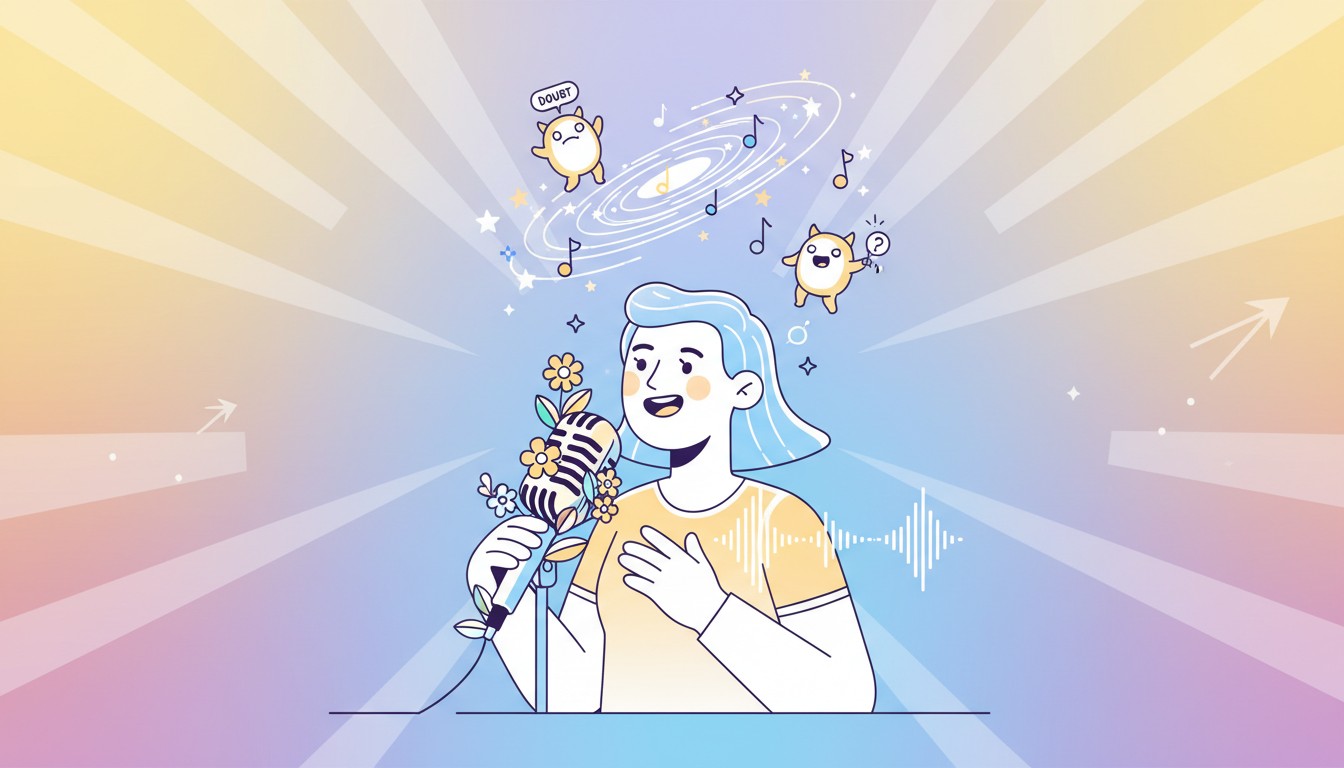
The microphone amplifies more than sound—it magnifies every insecurity you’ve ever had. According to research on imposter syndrome in content creators, 89% of podcasters experience persistent feelings of inadequacy, despite evidence of their competence. This isn’t stage fright; it’s a deeper conviction that you’ve somehow fooled everyone into thinking you’re qualified, and any moment now, they’ll discover the truth.
What makes this particularly cruel for podcasters is the isolation. Unlike other creative fields with built-in collaboration, most podcasters create alone, without real-time feedback. The mic captures every vocal tremor, every “um,” every moment of hesitation—and your brain catalogs each as proof of your unworthiness. Meanwhile, you’re comparing your episode 7 to someone else’s episode 200, not realizing they felt exactly the same way when they were where you are now.
The Invisible Architecture: Why Your Brain Becomes Your Enemy
Imposter syndrome operates through a sophisticated mental architecture that podcasters inadvertently build for themselves. The medium’s unique characteristics—recording without an immediate audience, hearing your own voice played back, competing in an oversaturated market—activate specific cognitive vulnerabilities that other creators don’t face.
The first is the voice confrontation phenomenon. Hearing your recorded voice triggers a neurological disconnect; your brain expects one sound and hears another, creating a primal “something is wrong” response. This isn’t vanity—it’s biological. Your voice sounds unfamiliar because you normally hear it through bone conduction, while recordings capture only air conduction. This perceptual mismatch becomes symbolic proof that you’re “not how you’re supposed to sound,” feeding the imposter narrative.
Second is the authority paradox. Podcasting demands you position yourself as knowledgeable, but genuine expertise comes with increased awareness of what you don’t know. As creators on “Let’s Talk Offline” describe, “the more you know, the more you realize what you don’t know.” This creates a crisis where your growing competence directly fuels your sense of fraudulence. You feel least qualified precisely when you’re becoming most valuable to your audience.
The Imposter’s Playbook: How Your Mind Sabotages You
The Comparison Engine: Measuring your episode 5 against someone’s episode 500, ignoring their episode 5 existed
The Expertise Filter: Dismissing your 5 years of experience because “someone else has 10”
The Originality Obsession: Abandoning episodes because “this topic has been covered,” despite your unique perspective
The Voice Critic: Hearing vocal fry, filler words, or “unprofessional” speaking patterns no listener notices
The Credential Scanner: Fixating on what degrees or certifications you lack, instead of what lived experience you possess
The Psychology of Creative Fraud: Why Podcasters Are Uniquely Vulnerable
Imposter syndrome thrives in podcasting because the medium perfectly aligns with three psychological conditions that breed self-doubt: asynchronous creation, metric opacity, and expertise visibility. Understanding these triggers reveals why you’re not broken—you’re operating in an environment designed to make you feel this way.
The Asynchronous Anxiety
Traditional speakers get immediate audience feedback—laughter, nods, questions. Podcasters speak into a void, recording words that won’t be heard for days or weeks. This time delay severs the connection between effort and reward, leaving your brain starved for validation. Without real-time data that you’re resonating, your mind fills the gap with worst-case scenarios: “They’ll think I’m stupid,” “This is boring,” “I have no right to talk about this.”
As Brené Brown discusses in her exploration of imposter syndrome, this disconnect between vulnerability and response creates a “shame spiral.” You share personal stories or hard-won insights, then wait in silence. The absence of immediate affirmation becomes proof that you’ve overshared or revealed your incompetence.
The Metrics Mirage
Download numbers are the ultimate Rorschach test for imposter feelings. A creator with 10,000 downloads per episode can feel like a failure if they believe they “should” have 100,000. The same number that would thrill a beginner becomes proof of inadequacy for an experienced podcaster. This is because imposter syndrome doesn’t scale with success—it scales with expectation.
Worse, podcast metrics lack context. You see downloads but don’t know if listeners finished the episode, hated it, or found it life-changing. This ambiguity becomes a canvas for projection. Low completion rates (if you can even access them) must mean you’re terrible. High downloads on one episode feel like a fluke you’ll never replicate. The data is neutral; your imposter mindset makes it toxic.
The Expertise Paradox
Here’s the cruel irony: imposter syndrome hits hardest those who are most qualified. The Dunning-Kruger effect’s evil twin means that genuine expertise brings heightened awareness of complexity. You know enough to recognize how much you don’t know, while beginners blissfully share oversimplified takes that feel more confident (but are less valuable).
This creates a vicious cycle where your growing competence makes you feel less qualified. By episode 15, you’ve interviewed experts, researched deeply, and refined your thinking. Instead of feeling authoritative, you realize the topic’s true depth and complexity. Your imposter syndrome whispers that you should wait until you “know more,” ignoring that the best podcasters are fellow learners, not infallible gurus.
The Imposter’s Timeline: How It Evolves With Your Show
Pre-Launch: “I need to read 20 more books before I’m ready to record”
Episodes 1-5: “My voice sounds terrible, and I’m embarrassing myself”
Episodes 6-12: “Who am I to talk about this when [famous expert] exists?”
Episodes 13-20: “My early episodes were so bad, I need to start over”
Episode 21+: “Eventually they’ll realize I have no idea what I’m doing”
Real-World Paralysis: When Imposter Syndrome Wins
The statistics are stark: imposter syndrome doesn’t just cause discomfort—it causes cancellation. Shows die not from lack of talent but from the host’s conviction that their talent is fake. These composite examples from creator communities illustrate the pattern.
The Consultant Who Couldn’t Claim Her Expertise
Sarah (name changed) launched a podcast about organizational change after 12 years as a successful consultant. Episodes 1-4 performed well, with listeners praising her actionable insights. But before recording episode 5, she discovered a similar podcast hosted by a Harvard professor. She spent three weeks rewriting her script, convinced hers was too “basic.” Episode 5 arrived a month late, filled with academic jargon she thought sounded more “legitimate.” Her audience engagement dropped 60%. Convinced this proved her inadequacy, she canceled episode 6 and posted a farewell message about “focusing on client work.” Her real clients had been begging for this content; the imposter won.
The Teacher Who Felt He Needed More Degrees
Marcus had taught high school history for 15 years and launched a podcast making historical events relevant to modern politics. His students loved it, but before episode 8, he became obsessed with the fact that he only had a master’s degree, not a PhD. He spent $3,000 on graduate courses he didn’t need, telling himself he’d resume the podcast “when I have my doctorate.” Two years later, he has the degree but the creative momentum is dead. The moment he felt unqualified passed, but the show never returned.
The Duo Where Both Hosts Felt Replaceable
Two friends started a wellness podcast, each secretly believing the other was the “real” talent. Neither voiced their insecurity. By episode 6, each had independently decided they were “holding the show back.” They began deferring to each other on every creative decision, creating bland, compromise episodes. Both privately thought, “Once they find someone better to co-host with, I’ll step aside.” The show died not from conflict but from mutual imposter syndrome—a phantom hostage situation where both hostages wanted to leave but were too afraid to say so.
The Imposter Syndrome Test: Are You Experiencing It?
Based on the Clance Imposter Phenomenon Scale adapted for creators:
1. I avoid hitting publish because I’m afraid listeners will discover I’m not as competent as I seem
2. I attribute my podcast’s success to luck, timing, or other people’s generosity—not my own effort
3. I’m constantly comparing my show to others and finding mine lacking
4. I feel like a fraud when listeners compliment my work
If you agree with 3+ statements, imposter syndrome is actively sabotaging your creative output.
The Rewiring Process: How to Reclaim Your Authority
Overcoming imposter syndrome isn’t about achieving enough—it’s about changing your relationship with “enough.” These strategies work not by eliminating doubt, but by creating systems that allow you to create despite it.
Collect Evidence Like a Lawyer
Imposter syndrome is a terrible judge of character, but it’s an excellent lawyer for its own case. It remembers every mistake, every critical comment, every moment of uncertainty. You need to build an equally compelling case for your competence. Create a “proof document” where you paste every positive listener email, every thoughtful comment, every moment when you helped someone. When the imposter voice speaks, read it out loud. You’re not stroking your ego; you’re presenting evidence the way a jury needs to see it.
Redefine “Expert” as “Experienced Learner”
The imposter voice says you need to be the authority. Your audience wants you to be a fellow explorer. Shift your positioning from “I have all the answers” to “I’m asking the questions you’re also asking, and here’s what I’m discovering.” This isn’t false modesty—it’s the most honest approach. As The Imposter Club podcast demonstrates, the most powerful content comes from creators who admit they’re “winging it” and invite listeners on the journey.
Voice Exposure Therapy
If hearing yourself triggers imposter feelings, you need systematic exposure. Record 5-minute voice notes daily and listen back immediately. Don’t judge—just observe. Notice that your voice is consistent, that filler words decrease over time, that you sound more like “yourself” than you think. The goal is habituation: making your recorded voice as boring and neutral as your reflection in the mirror. Once it’s no longer a source of shock, it can’t fuel imposter narratives.
The 10-Episode Immunity Rule
Imposter syndrome thrives on novelty. By episode 10, you’ve survived the cycle of creation enough times that your brain starts accepting “podcaster” as part of your identity. So commit to publishing 10 episodes before you even question if you’re qualified. Think of it as a vaccination series—you need all doses before immunity kicks in. Don’t evaluate your fit until you’ve crossed this threshold. The imposter voice screaming at episode 7 is expected; it’s just part of the process.
You Are the Only You
The ultimate antidote to imposter syndrome isn’t confidence—it’s specificity. No one else has your exact combination of experiences, perspective, and voice. Someone else may know more about your topic, but they can’t tell your stories. They can’t share your insights. They can’t connect with your particular audience the way you can.
Imposter syndrome wants you to believe you’re a replaceable fraud. The truth is, you’re an irreplaceable filter through which your expertise passes. Your listeners aren’t tuning in for perfect expertise. They’re tuning in for you—for your way of explaining things, your curiosity, your honest struggle with the same questions they have.
The mic feels heavy because it carries truth. Your truth. Speak it anyway. The imposter is just the voice of fear, mistaking vulnerability for weakness. But vulnerability is the exact ingredient that makes podcasting powerful. Your doubt isn’t a bug in the system—it’s proof you’re human. And humans, not flawless experts, are who we want to listen to.
Key Takeaways
Imposter syndrome affects 89% of podcasters, making it the #1 psychological barrier to sustained content creation.
The medium’s unique triggers—voice confrontation, asynchronous creation, and metric opacity—amplify feelings of fraudulence.
Imposter syndrome peaks at different episodes: voice shame early, authority paradox mid-run, and comparative despair throughout.
Overcoming it requires evidence collection, identity reframing, and systematic exposure—not waiting for confidence to arrive.
Your specific combination of experience and perspective is irreplicable; vulnerability is the feature, not the bug.