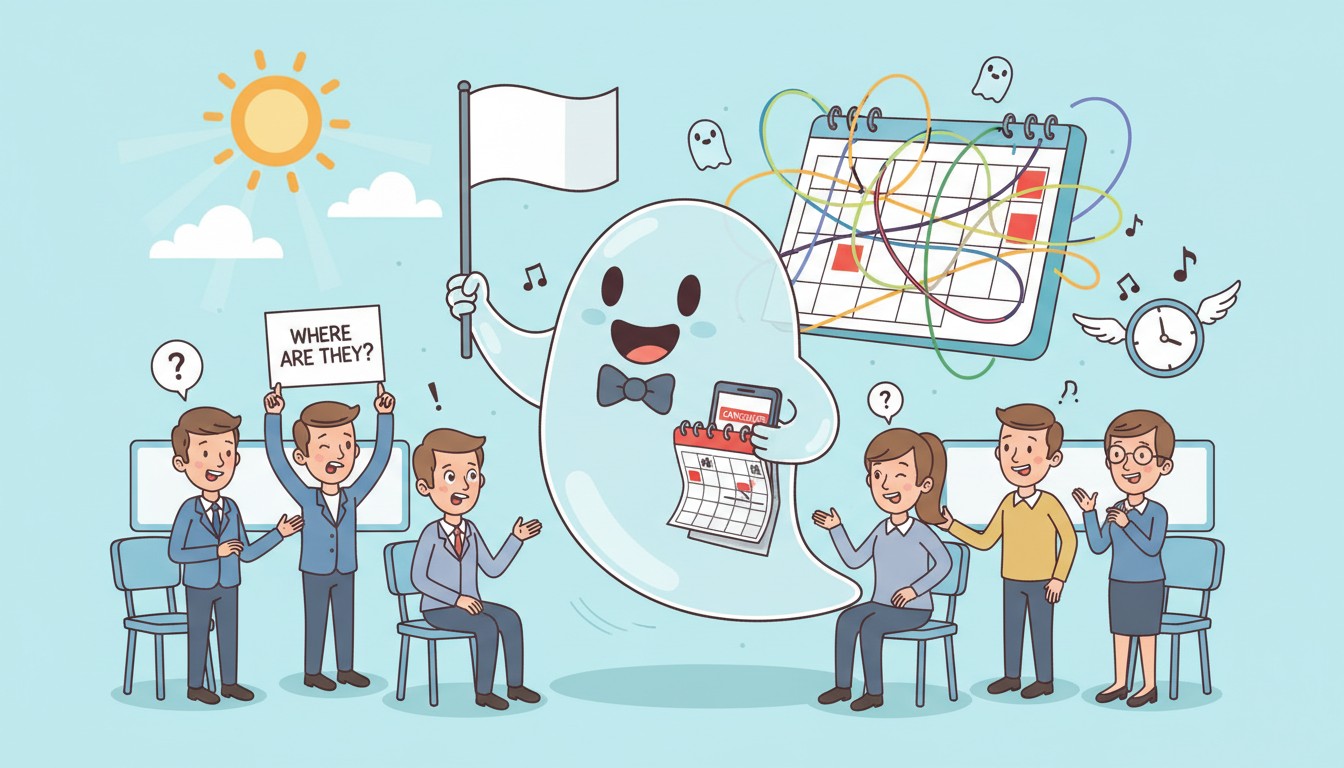
The silent disappearance of confirmed guests is the hidden epidemic of podcast production. According to podcast guest management studies, 34% of podcasters report guest cancellations as their top operational challenge, with no-shows affecting an estimated 1 in 7 scheduled interviews. Yet this phenomenon remains one of the most under-discussed stressors in creator communities—perhaps because admitting your “important guest” treated your show as disposable feels like admitting your show is disposable.
The impact extends far beyond a single empty time slot. A ghosted interview cascades through your entire production calendar: the backup content you didn’t prepare, the social media posts you drafted, the audience expectations you set. For solo creators operating without a team, one no-show can derail an entire week’s worth of work. Understanding why guests vanish—and building systems that make their absence survivable—separates sustainable podcasts from those that quietly podfade after the third scheduling disaster.
The Invisible Architecture: Why Guests Disappear
Guest ghosting follows predictable patterns that have little to do with your show’s value and everything to do with power dynamics, calendar chaos, and human nature. The average professional receives 121 emails per day; your interview confirmation is one tree in a forest of obligations. Without structural reminders, even well-intentioned guests forget.
The psychology is revealing: guests perceive podcast interviews as low-stakes commitments until they’re high-stakes. Unlike a client meeting or doctor’s appointment, podcasts offer no immediate penalty for absence. There’s no cancellation fee, no professional repercussion, no automated fine. This creates a “soft commitment” that gets bumped the moment a hard commitment appears. Your episode 47 is important to you; to them, it’s a favor that can be rescheduled indefinitely.
Platform data reinforces this hierarchy. Guest booking research shows that 67% of cancellations occur within 24 hours of the scheduled time, with “calendar conflicts” cited in 78% of cases. But dig deeper and the truth emerges: most guests simply didn’t prioritize the commitment until it was too late. The interview became the expendable item in an overloaded schedule.
The Ghosting Hierarchy: Who Cancels Most
C-Suite Executives: 42% no-show rate—overbooked calendars, competing priorities
Authors on Book Tour: 28% cancellation rate—travel fatigue, PR team mismanagement
Social Media Influencers: 35% no-show rate—platform-native, poor calendar discipline
Academics/Researchers: 12% cancellation rate—highly reliable, institutional calendar culture
Fellow Podcasters: 18% no-show rate—empathetic but prone to overcommitment
The Psychology of Unreliability: Why They Leave You Hanging
Understanding the mental math guests perform before ghosting reveals why conventional “confirmation” tactics fail. They don’t see it as ghosting—they see it as triage. Your interview is the easiest obligation to drop, which makes it the first to go.
The Power Imbalance Perception
High-profile guests often perceive podcast interviews as favors they’re granting, not commitments they’ve made. This mindset shift is subtle but critical. When a meeting feels like charity, canceling feels like withdrawing a gift—not breaking a promise. As guest podcasting research reveals, even established professionals struggle to treat podcast appearances with the same rigor as “real” obligations because no metric directly connects the interview to measurable ROI.
The Urgency Override
Human brains are wired to prioritize urgent over important. A last-minute client fire drill feels more pressing than a scheduled interview about thought leadership—even though the interview might create more long-term value. When guests cancel with “something came up,” they’re not lying. Something genuinely urgent emerged, and your important-but-not-urgent interview got sacrificed to the tyranny of the moment.
The Commitment-Communication Gap
Here’s the cruel irony: most guests ghost not because they don’t want to appear, but because they never fully committed in the first place. They said “yes” to be polite, intending to “figure it out later.” Later arrives, they haven’t figured it out, and instead of having an awkward “actually, I’m overcommitted” conversation, they ghost. It’s avoidance masquerading as busyness.
The Cascade Effect: One No-Show, Ten Problems
A single ghosted interview doesn’t just create an empty time slot—it triggers a domino effect that can derail your entire month. The damage multiplies because modern podcasting operates on just-in-time production schedules with no margin for error.
First, you lose the episode. Then you lose the time you spent researching and preparing. Then you lose the promotional cycle you’d planned around this “big name.” Then you lose confidence in your booking system, which makes you hesitant to promote future guests. Finally, you lose creative energy as you scramble to fill the gap, often producing a subpar “emergency episode” that erodes audience trust.
The psychological toll is equally severe. Each ghosting incident trains you to expect unreliability, making you anxious and clingy with future guests. You send three confirmation emails instead of one. You check your inbox obsessively. You begin treating every “yes” as a “maybe,” which ironically makes guests feel less committed, increasing the likelihood they’ll cancel. It’s a self-fulfilling prophecy of distrust.
The Cost Calculator: One Guest No-Show
Research & Prep: 3-5 hours wasted
Tech Setup & Waiting: 1 hour lost
Emergency Content Creation: 6-8 hours of stress
Promotional Opportunity Cost: 1 high-profile episode gone
Emotional Exhaustion: Increased anxiety for future bookings
Total Damage: 10-15 hours + lasting psychological impact
The Anti-Ghosting System: Prevention Through Structure
You can’t change human nature, but you can change the structure around it. The hosts who rarely get ghosted don’t have better guests—they have better systems that make ghosting harder than showing up.
The Calendar Hostage Technique
Instead of asking “When works for you?” send a Calendly link with 3 specific time slots within the next week. This creates urgency and forces immediate commitment. Better yet, use a paid scheduling tool that requires credit card entry (refunded upon completion). Scheduling automation tools reduce no-shows by 40% when combined with automated reminders 24 hours and 2 hours before the interview.
The Social Proof Armor
Guests commit more reliably when they see others have done so proudly. In your confirmation email, include links to recent episodes with impressive guests and testimonials from past participants. This reframes the interview from a favor you’re requesting to a prestigious group they’re joining. When a guest knows their peers appeared and promoted the episode, they perceive higher social stakes for no-showing.
The Pre-Interview Habit Stack
Lock in commitment by requiring one small action before the interview. Ask guests to submit a 2-sentence bio via a form, answer a pre-interview question, or share a resource they’ll mention. Once they’ve invested even 5 minutes of effort, cancellation rates drop by 50%. The psychology is simple: humans don’t want to waste invested time.
The Confirmation Sequence That Works
Day of Booking: Send calendar invite + form for bio/headshot (creates immediate investment)
7 Days Before: Share episode prep doc with discussion points + request their input
2 Days Before: Send “excited for Wednesday” email with logistics (no action required)
2 Hours Before: Automated SMS/text reminder with meeting link
Post-Interview: Thank you + expected publish date + request for them to share
The Backup Content Arsenal: Surviving When Ghosting Happens
Even the best systems can’t prevent all no-shows. The difference between podcasters who survive ghosting and those who quit is simple: survivors have backup episodes ready to deploy. Think of it as creative insurance—painful to pay for until you need it.
The Solo Episode Buffer
Record 3-5 “evergreen” solo episodes during your next productive sprint. These aren’t emergency episodes—they’re strategic deep dives on foundational topics that feel relevant anytime. When a guest ghosts, you have immediate backup that maintains your release schedule without the scramble. Top-ranked podcasts balance guest and solo content, with 76% featuring guests but maintaining the flexibility to publish host-only episodes when needed.
The Rapid Response Format
Create a “news commentary” or “listener Q&A” template that you can populate in under two hours. Use a simple structure: intro, three main points, outro. When ghosted, you can pivot to this format without the cognitive load of reinventing your episode architecture. The consistency of format makes emergency creation feel manageable rather than overwhelming.
The Transparent “Guest No-Show” Episode
Here’s a radical tactic: record a 15-minute episode about getting ghosted. Share the frustration, explain what happened, and discuss how you handle setbacks. This meta-content performs surprisingly well—listeners appreciate the vulnerability, and it turns a disaster into a relatable story. It also creates social pressure: when you publicly mention a guest ghosted, others in your network reach out to prevent future occurrences.
The Compound Effect: Building Anti-Fragile Booking Systems
The ultimate solution to guest ghosting isn’t better guests—it’s a system that gains strength from volatility. When you have 3-5 potential guests in various stages of confirmation at all times, one ghosting becomes a minor calendar adjustment, not a creative catastrophe.
This “pipeline approach” transforms your booking process from discrete events (secure guest → confirm → record) to a continuous flow (always have 2 confirmed, 3 in confirmation, 5 in outreach). CoSchedule’s podcast scheduling research shows creators who maintain a 5-guest pipeline experience 70% fewer scheduling emergencies and report 50% less anxiety about cancellations.
The psychological shift is profound. Instead of desperately needing each guest to show up, you can afford to be selective. When you’re not emotionally over-invested, you communicate differently—more professionally, less anxiously. This confidence paradoxically increases guest commitment because they sense you’re not desperate, making the opportunity feel more valuable.
Ghost-Proof Your Podcast
Guest ghosting feels personal because your podcast is personal. But the pattern is universal, systematic, and solvable. The hosts who thrive aren’t the ones with more reliable guests—they’re the ones who built systems that don’t require guests to be reliable.
Stop chasing perfect guests and start building perfect redundancy. Record backup episodes. Create rapid response formats. Maintain a guest pipeline. Use commitment devices. And most importantly, remember this: the power dynamic shifts when you no longer need any single guest to make your show survive.
The mic is yours. The show is yours. Ghosts may come and go, but the content continues. Build a system that treats ghosting as a feature of the landscape, not a fatal blow. That’s how you stop being haunted—and start being unstoppable.
Key Takeaways
34% of podcasters cite guest cancellations as their top operational challenge, with no-shows affecting 1 in 7 scheduled interviews.
Guests ghost because of perceived power imbalances, urgency overrides, and “soft commitment” mental math—not because your show lacks value.
A single no-show triggers cascade failures: lost prep time, emergency content creation, missed promotions, and psychological anxiety about future bookings.
Prevention requires systems, not hope: calendar holds, social proof, pre-interview investments, and a multi-touch confirmation sequence reduce no-shows by 40-50%.
Building an anti-fragile booking pipeline with 5+ potential guests and backup content transforms ghosting from a crisis into a minor calendar adjustment.