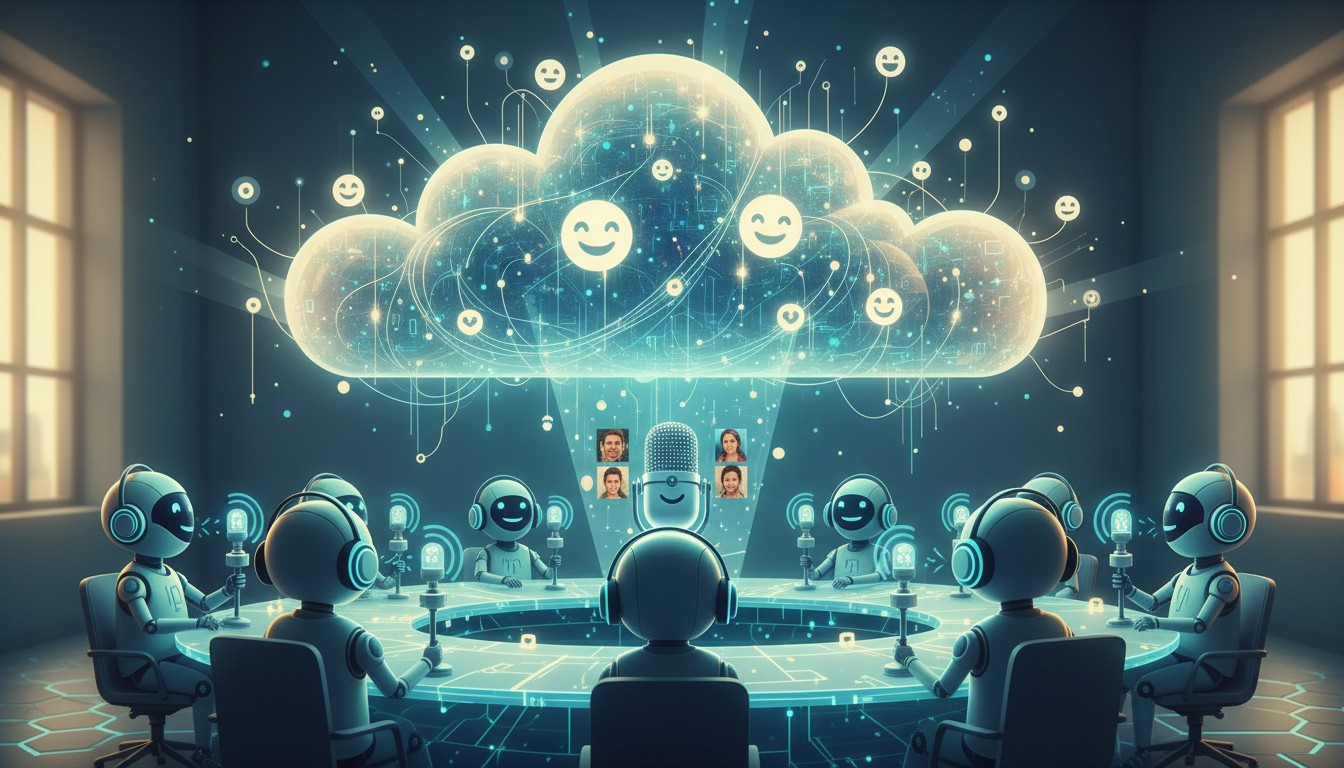
The podcast industry stands at a wrenching crossroads. According to industry predictions, 90% of podcasts will be AI-generated within the next year—a staggering figure that sounds like hyperbole until you inventory the tools already embedded in production pipelines. AI now writes scripts, clones voices, edits audio, generates show notes, translates content into dozens of languages, and even recommends what topics will trend next. The walls between human creativity and machine optimization are dissolving, and the conversation about whether this is progress has barely begun.
This isn’t just a backend efficiency upgrade. It’s an existential threat that attacks podcasting on three fronts: the authenticity that builds trust, the economics that sustain creators, and the discovery systems that help quality content surface. While industry executives tout AI as a “co-creator” that democratizes production, the darker reality emerges in FBI warnings about AI-powered voice cloning scams and specialists’ concerns that we’re entering an era of “podcast spam” where soulless audio sludge drowns out human voices. The future nobody asked for is arriving anyway, wrapped in the promise of infinite content.
The Automation Avalanche: When Tools Become Replacements
The AI podcasting toolkit has expanded from transcription assistance to full-stack production. Adobe’s Enhanced Speech removes background noise and polishes amateur recordings into studio quality. Descript allows creators to edit audio by editing text, deleting filler words with a single click. Programs like Momento generate full transcripts and show notes in minutes. These tools lower barriers for independent creators who can’t afford professional studios or editors.
But the line between assistance and replacement blurs dangerously. When the same AI that cleans your audio can also write your script, generate a synthetic host voice, and A/B test your episode titles for maximum click-through, what remains for the human creator? The threat isn’t that AI will make bad podcasts—it’s that it will make just good enough podcasts at a scale that makes human competition economically irrational.
Consider Inception Point AI, which is churning out over 3,000 episodes using entirely synthetic hosts and algorithmically assembled scripts. Their closest competitor, PocketFM, uses ElevenLabs voice generation to produce nearly 1,000 pilot episodes monthly. This volume strategy treats content as a commodity, not craft. The economic logic is seductive: why pay writers, voice actors, and editors when a subscription service can generate unlimited episodes for pennies on the dollar?
The 90% Problem: Quantity vs. Quality
Pre-AI Era: 600,000 active podcasts, high barrier to entry ensured baseline commitment
Current Trajectory: AI tools reduce production time by 85%, enabling exponential content multiplication
Predicted Outcome: 90% AI-generated content within 12 months, but only 10% of listened-to hours
The Paradox: More content than ever, but listeners report increased difficulty finding shows worth finishing
The Authenticity Collapse: When Trust Becomes a Currency
Podcasts built their cultural power on intimacy. The voice in your earbuds felt like a trusted friend sharing genuine curiosity, anger, or wonder. This parasocial relationship—the illusion of personal connection—depends entirely on perceived authenticity. When listeners discover that warm, empathetic host voice is synthetic, the betrayal cuts deeper than with text or video because audio feels more viscerally human.
Research from Sounds Profitable reveals a striking demographic split: 49% of post-graduate degree holders express strong resistance to AI voices, compared to 31% of those with high school education. This isn’t snobbery—it’s informed wariness. The college-educated demographic most likely to work in creative fields correctly identifies AI podcasting as an existential threat to an entire class of knowledge workers. They understand that when algorithms can replicate the surface qualities of human communication, the value of genuine human labor collapses.
The psychological danger extends beyond economics. AI systems engineered to maximize engagement risk eroding human judgment itself. When synthetic hosts are optimized to mirror your preferences, predict your emotional states, and deliver content that keeps you listening, you’re not experiencing genuine connection—you’re being algorithmically managed. The danger isn’t sentient machines; it’s our surrender to code that mimics empathy while serving engagement metrics.
This authenticity gap creates a trust vacuum. How will listeners verify that a host’s personal story is real, their reaction spontaneous, their research diligent? Academic sites already auto-generate podcasts from research papers without authors’ consent, using AI voices that sound authoritative but lack true understanding. When surfaced in search results, these synthetic shows dilute trust in all audio content, human or machine-made.
The Co-Creator Illusion
Industry advocates frame AI as a “co-creator” that handles tedious tasks, freeing humans for creative work. Adobe’s Enhanced Speech helps any podcaster sound professional. AI transcription tools like Otter.ai and Descript accelerate editing. These are genuine benefits.
But this narrative masks the slippery slope. When AI generates your episode outline, writes your ad copy, and polishes your delivery, how much “you” remains? The co-creator framing is strategic misdirection—it positions AI as an assistant while quietly assuming core creative functions. The real threat isn’t that AI will take podcasting jobs; it’s that it will devalue the human element so thoroughly that those jobs cease to exist as viable careers.
The Authenticity Gap in Numbers
68% of listeners say “personal connection to the host” is their primary loyalty driver
76% express uncertainty about how to identify AI-generated voices
23% report they would stop listening to a show if they discovered it used synthetic hosts
<5% of podcast platforms currently require AI disclosure
The Spam Tsunami: Discoverability in the Age of Infinite Content
The most immediate threat AI poses isn’t philosophical—it’s mechanical. Podcast platforms already struggle with discoverability; adding AI-generated content at scale could collapse the ecosystem. When anyone can generate 50 episodes on “True Crime in Small Towns” or “Startup Success Secrets” with zero production cost, the feed becomes a wasteland of SEO-optimized sludge.
This oversaturation follows the trajectory of blogs and social media. Initial AI content will be mediocre but passable. As algorithms improve, distinguishing human from machine becomes functionally impossible for casual listeners. The platforms’ response will likely favor engagement metrics, creating a race to the bottom where synthetic hosts optimized for maximum outrage and minimum substance dominate.
The economic incentives are perverse. A human creator spending 20 hours researching, recording, and editing a single episode cannot compete with an AI system producing 100 episodes daily. The platform’s algorithms, hungry for fresh content, will reward volume over quality. Human creators face a choice: adopt AI tools to keep pace, accepting the devaluation of their craft, or maintain artistic integrity and become invisible in an ocean of machine-made content.
The Security Shadow: Weaponized Voice Technology
Beyond economic and philosophical threats lies a darker danger. The same AI voice technology that creates synthetic podcast hosts can clone real voices for malicious purposes. The FBI has explicitly warned that cybercriminals are leveraging AI for sophisticated phishing and voice cloning scams, creating audio so realistic it can fool family members and business partners.
Imagine a synthetic podcast that sounds like your favorite true crime host but subtly shifts facts to serve a political agenda. Or a financial advice show using a cloned celebrity voice to promote fraudulent investments. The technology exists now. The only barrier is will, and history suggests bad actors move faster than platform regulators.
This threat extends to privacy. AI transcription tools like Otter.ai, Rev.ai, and Descript process sensitive conversations on external servers, creating data retention risks. For podcasters interviewing vulnerable sources—whistleblowers, abuse survivors, political dissidents—using AI tools could expose them to legal or physical danger if subpoenaed or breached. State regulations like HIPAA and GDPR are already struggling to address these vulnerabilities.
Industry Silence: Why Platforms Aren’t Addressing the Threat
Remarkably, the podcast industry itself is largely silent on AI threats. At the recent IAB Podcast Upfront in Manhattan, executives celebrated the medium’s intimacy and advertiser efficacy while conspicuously avoiding discussion of artificial intelligence. When mentioned, AI was framed as a backend tool for “creative optimization” and “streamlined editing”—never as a threat to creators or listeners.
This strategic blindness serves platform economics. Apple Podcasts, Spotify, and YouTube don’t require creators to disclose AI usage. There’s no authentication system to verify a voice is human. No standards for labeling synthetic content. The platforms profit from infinite content regardless of its origin; they have no incentive to erect barriers that might slow the feed.
Contrast this with the skepticism from veteran creators. Ryan Jann, EVP at Wave Sports + Entertainment, notes that “no computer personality can replace the humor that Funny Marco brings, or the realness that Kylie Kelce brings.” Joe Caporoso of Whistle sees AI value for “formulaic parts of episodes, like ad reads,” but doubts it can handle natural conversation flow. The gap between platform silence and creator concern reveals where the power lies—and who stands to lose when authenticity becomes optional.
The Compound Effect: Small Automations That Erode Human Value
The real threat of AI podcasting isn’t a sudden robot takeover—it’s the slow devaluation of human creativity through compound automation. Each small task AI assumes (transcription, noise removal, script drafting) seems benign in isolation. Together, they create a production pipeline where human input becomes optional, then superfluous, then commercially unsustainable.
This follows the same pattern as previous technological disruptions. Photographers who embraced digital editing found themselves competing with smartphone filters. Journalists who used AI transcription tools watched their newsrooms replace them with content farms. At each step, defenders argue that “real talent will always be valued.” But markets don’t reward talent—they reward cost-efficiency at sufficient scale.
The compound effect manifests in listener behavior. Even if you personally refuse AI podcasts, algorithmic curation means you’ll encounter them. If they’re “good enough” and release daily, while your favorite human creator drops episodes weekly, the algorithm promotes the AI show. Your listening time shifts. Your expectations adjust. Eventually, the baseline for “acceptable content” lowers, and human creators must either adopt AI or become hobbyists.
The Value Collapse Cascade
Phase 1: AI assists with transcription and editing → Human time investment drops 60%
Phase 2: AI generates scripts and interview questions → Human creativity becomes curation, not creation
Phase 3: AI voices and hosts → Human talent becomes an expense, not a necessity
Phase 4: AI optimizes for engagement → Human authenticity becomes a liability to scale
Practical Defense: How to Protect Human-Created Audio
The AI podcasting threat feels overwhelming, but it’s not inevitable. Listeners, creators, and platforms can take concrete actions to preserve the human element that makes audio storytelling powerful.
For Listeners: Become Conscious Consumers
Your listening choices are votes. Support shows that disclose their production process. Look for “recorded live” indicators, genuine guest interactions, and host mistakes—these imperfections are authenticity markers. If a show feels suspiciously perfect (never a misspoken word, always exactly 28 minutes), investigate. Transparency isn’t just ethical; it’s a feature.
For Creators: Build the Un-AI-Able Brand
Double down on what machines can’t replicate: live events, genuine mistakes, off-the-cuff reactions, community interaction. Host a live Q&A where listeners hear you think in real-time. Share your production failures. Build a brand around your humanity, not despite it. The more your audience feels they know you, the harder you are to clone credibly.
For Platforms: Mandate Transparency
Platforms must require AI disclosure, similar to paid sponsorship labels. Implement voice authentication for verified creators. Create “human-made” filters for listeners who want them. These aren’t technical impossibilities—they’re policy choices that prioritize creator rights and listener trust over engagement volume. Government agencies are already establishing AI risk frameworks that platforms could adopt voluntarily.
For Advertisers: Value Authenticity Over Impressions
Brands must recognize that advertising on AI-generated content carries reputational risk. If your product appears in a synthetic show that later spreads misinformation, the association damages your brand. Insist on human-host verification. Pay premium rates for shows that maintain human production standards. Economic pressure from advertisers can shift platform priorities faster than listener complaints.
The Choice Between Connection and Content
The AI podcasting future isn’t a foregone conclusion. It’s a choice we’re making daily through what we create, what we promote, and what we choose to hear. The algorithms will always promise more—more episodes, more perfection, more optimization. But “more” isn’t what made podcasts matter.
What made podcasts matter was the voice that cracked during an emotional story. The host who forgot a guest’s name and laughed about it. The inside joke that became a community motto. The feeling that someone else, somewhere, understood your weird obsession with 18th-century naval battles or niche productivity systems.
You can’t algorithmically generate that connection. You can only preserve it—by listening consciously, creating defiantly, and demanding that platforms protect the human voices that built this medium. The future of podcasting isn’t about more content. It’s about remembering why we valued human voices in the first place, and refusing to let them be optimized out of existence.
Key Takeaways
AI podcasting tools that assist with editing and transcription are rapidly evolving into full-stack production systems that can generate scripts, clone voices, and produce entire shows without human input.
The predicted 90% AI generation rate within a year threatens to flood platforms with “podcast spam,” making discoverability nearly impossible and devaluing human-created content.
Authenticity—the core value proposition of podcasting—faces collapse as listeners struggle to identify synthetic voices and lose trust in the medium’s intimate connection.
Security risks including voice cloning scams, data exposure from transcription tools, and disinformation campaigns pose immediate dangers beyond economic disruption.
Protecting human podcasting requires conscious listener choices, creator strategies that emphasize un-automatable qualities, and platform policies mandating transparency and authentication.