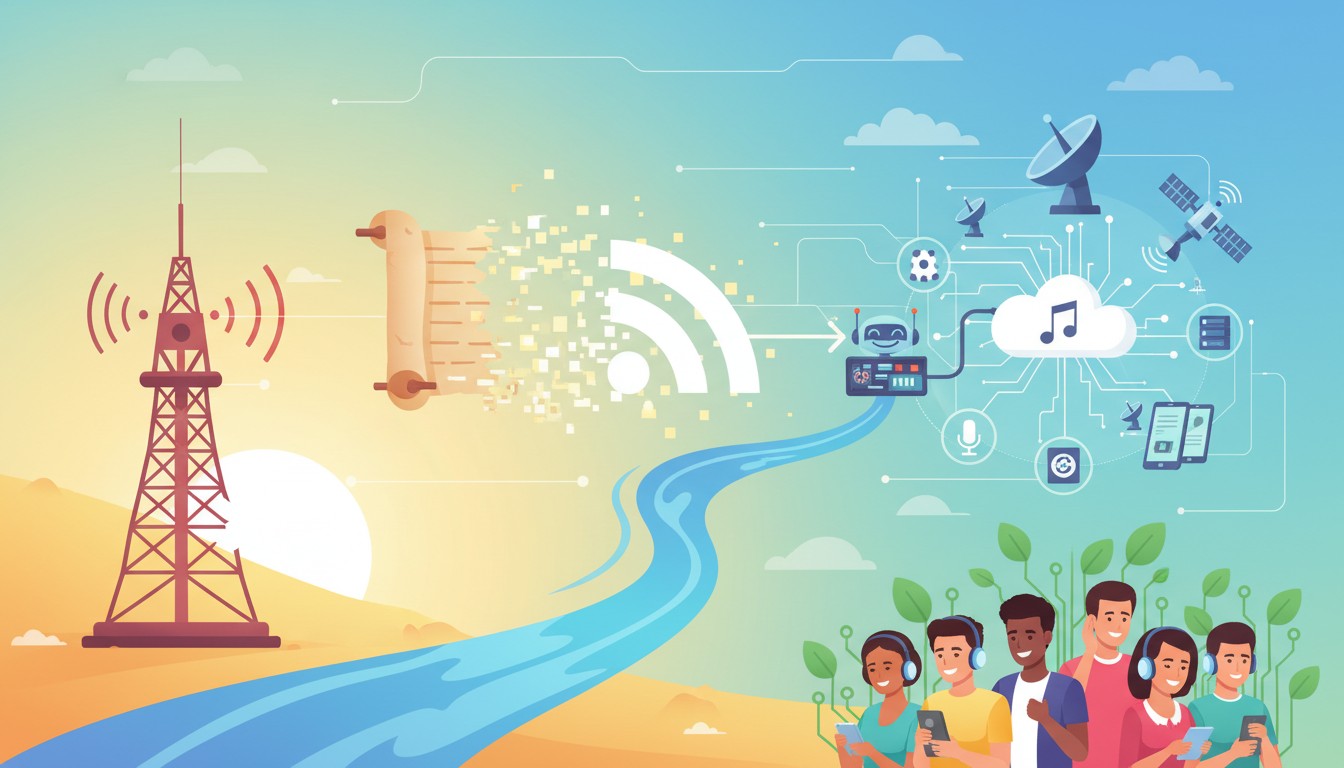
The RSS feed, that unglamorous XML file that transformed podcasting into an open ecosystem, is dying—not with a spectacular crash, but with a thousand technical cuts. Apple Podcasts quietly deprecated the `
This shift isn’t about user experience—it’s about platform control. RSS gave creators power: one feed distributed everywhere, audience ownership, platform independence. Modern distribution gives platforms power: algorithmic curation, data hoarding, and lock-in. The technical simplicity that launched a million podcasts is being traded for technical complexity that serves platform economics.
RSS: The Open Protocol That Built Podcasting
RSS (Really Simple Syndication) is ingeniously simple. It’s an XML file hosted on a creator’s server containing episode metadata: titles, descriptions, audio file URLs, publication dates. Platforms like Apple Podcasts, Spotify, and Overcast “poll” this feed periodically—every few minutes to every few hours—checking for new `
This architecture created podcasting’s core values:
- Decentralization: No single platform controlled distribution
- Ownership: Creators owned their audience relationship
- Permanence: Episodes lived at permanent URLs, immune to platform shutdown
- Simplicity: Any developer could build a podcast app by parsing RSS
But RSS’s simplicity is also its technical limitation. It’s a “pull” system—platforms pull data when they decide to check. For creators, this means unpredictable publication delays and zero control over when audiences see new episodes. For platforms, it means massive server load, bandwidth waste, and inability to gather real-time analytics.
Platform Betrayal: How Tech Giants Are Dismantling RSS
The technical assault on RSS isn’t coordinated—it’s convergent. Each platform is optimizing for its own business model, and RSS doesn’t fit.
Apple Podcasts: The Standard-Bearer Stumbles
Apple created the modern podcast industry by adding RSS support to iTunes in 2005. But their 2023 technical updates reveal a platform backing away from open standards:
- Owner Tag Deprecation: The `
- GUID Requirements: While GUIDs provide unique episode IDs, making them mandatory gives Apple more control over feed processing
- Atom Feed Death: Atom, an alternative syndication format, is no longer accepted—RSS or nothing
- Conditional GET: While this optimizes bandwidth, it requires hosting providers to implement ETag headers, a technical burden that pushes creators toward Apple-preferred hosts
Apple’s RSS crawler is also notoriously unreliable. Feed refreshes can take “up to 24 hours,” with no manual override except for metadata changes. Creators report episodes taking days to appear, RSS feeds mysteriously failing validation despite being technically correct, and Apple Podcasts Connect providing minimal diagnostic tools.
YouTube: The Closed Garden PRETENDS to Support RSS
YouTube’s RSS integration is technically a bait-and-switch. Creators can submit an RSS feed, but YouTube immediately breaks the RSS contract:
- No Automatic Updates: Edit your episode description in your RSS feed? YouTube ignores it unless you manually re-upload
- One-Way Street: YouTube ingests from RSS but provides no RSS output—your YouTube audience is locked in their ecosystem
- Content Restrictions: RSS-fed episodes cannot contain third-party ads, a rule that doesn’t apply to native YouTube uploads
- No Backdating Notifications: Adding old episodes via RSS won’t notify subscribers, making archival content invisible
As Descript bluntly states: “Edit in YouTube once, edit in YouTube forever”. The platform is designed to capture creators, not support open distribution.
Spotify: Building a Walled Garden
Spotify’s strategic shift is most explicit. By rebranding “Spotify for Podcasters” to “Spotify for Creators” and prioritizing video, they’re sidelining RSS distribution for video podcasts entirely. Audio podcasts still use RSS (for now), but video requires direct upload, eliminating dynamic ad insertion and restricting analytics visibility.
The technical implications are stark: Spotify’s closed system means creators lose log-level data, granular listener behavior insights, and the ability to serve targeted ads programmatically. You’re forced into Spotify’s ad system, their analytics, and their monetization rules. The RSS feed becomes a legacy bridge to audio-only distribution, while the platform’s real investment flows toward native video content.
The Technical Debt: Why RSS Can’t Compete
RSS wasn’t designed for modern podcasting’s scale and complexity. Its technical limitations create real problems that platforms are “solving” by abandoning it.
Bandwidth Inefficiency
Every time a platform polls an RSS feed, it downloads the entire XML file. For popular podcasts with 500+ episodes, that file can be 500KB+ and contain data the platform has already seen. Servers waste terabytes processing redundant requests from thousands of podcast apps checking feeds every few minutes.
Apple’s “Conditional GET” requirement attempts to fix this using ETag headers, but implementation is inconsistent across hosting providers. Meanwhile, platforms with APIs can push updates instantly, eliminating polling waste entirely.
Feed Errors and Validation Hell
RSS is unforgiving. A single invalid character, missing closing tag, or improperly encoded special character can break the entire feed. Ausha’s troubleshooting guide lists common RSS feed errors: incorrect formatting, missing mandatory fields, broken URLs, special characters platforms can’t read.
Tools like Podbase and Cast Feed Validator help, but they can’t fix the fundamental fragility. When Apple’s crawler encounters an error, it often provides zero diagnostic feedback—just silence. Creators are left guessing which invisible character broke their distribution to millions of listeners.
Migration Nightmares
Switching hosting providers requires a perfect 301 redirect from the old RSS feed to the new one. Transistor’s migration guide emphasizes this single point of failure: “Without a proper redirect, platforms might continue polling your old RSS feed, causing your latest episodes to disappear.”
Many creators discover too late that their old host’s redirect broke, or they didn’t maintain the `
The Algorithmic Coup: Discovery Over Subscription
The deepest technical shift isn’t in feed formats—it’s in how audiences find content. RSS enabled subscription-based listening: you chose shows, subscribed via RSS, and got every episode. This “pull” model gave listeners control but limited platform growth.
Algorithmic discovery is a “push” model: platforms analyze behavior and push content they think you’ll like. MIDiA Research calls this “the podcast attention game,” noting that RSS distribution meant podcasts “lived beyond the algorithm.” Now they’re being pulled into it.
The technical implications are profound:
- Feed data is insufficient: Algorithms need behavioral data—what you listened to, when you skipped, what you shared. RSS provides none of this.
- Platform lock-in: Algorithmic recommendations only work within a single platform. There’s no cross-platform subscription portability.
- SEO over RSS: Creators now optimize for YouTube search keywords and Spotify recommendation triggers, not RSS feed structure.
This shift explains why platforms are de-prioritizing RSS: it’s technically incompatible with their business model. You can’t personalize recommendations across open feeds. You can’t sell targeted ads without behavioral data. You can’t keep users trapped in your ecosystem if they can freely subscribe anywhere.
The Subscription Paradox
RSS Era: 100% of listeners were subscribers who chose your show
Algorithmic Era: 60-70% of listeners are “drive-by” algorithm recommendations
The Result: Higher reach, but lower loyalty and unpredictable audience composition
Real-World Impact: Creator Nightmares in the RSS Twilight
The technical decay of RSS creates daily crises for creators who built their businesses on open distribution assumptions.
The Mysterious Disappearing Episode
A creator publishes an episode at 9 AM. It appears on Spotify by 9:15. By noon, it’s still absent from Apple Podcasts. The RSS feed is valid. There’s no error message in Apple Podcasts Connect. Support tickets go unanswered for days. The episode finally appears 48 hours later, after the promotional window has closed.
This scenario is common. Apple’s RSS crawler operates on an opaque schedule, sometimes checking feeds every 30 minutes, sometimes every 6 hours. There’s no push notification API. No webhook. No way to tell Apple “hey, I published, please check now.” The “Refresh Feed” button is placebo—it only works for metadata, not new episodes.
The YouTube Ingestion Trap
A podcaster connects their RSS feed to YouTube, importing 100 episodes. They later update episode descriptions in their RSS feed to fix errors and improve SEO. The changes propagate to Spotify and Apple Podcasts seamlessly. YouTube? The old, incorrect descriptions remain forever. They’ve been “locked” by YouTube’s system.
YouTube’s documentation admits this limitation: “Editing your episode details on YouTube will block any future edits in the RSS feed.” This technical decision creates a permanent fork: your RSS feed and YouTube version are now two different shows, diverging over time.
The Spotify Analytics Blackout
A creator switches from an RSS-based audio podcast to Spotify-native video. Overnight, they lose access to log-level analytics. They can’t see listener drop-off rates, can’t A/B test ad placements, can’t export raw data for sponsorship negotiations. Spotify provides aggregated metrics only—total views, average watch time—data that’s useless for optimizing content or proving value to advertisers.
This data loss is irreversible. The open RSS ecosystem allowed creators to choose analytics providers. The closed platform requires accepting their limited dashboards. As CoHost explains, “Spotify’s closed system restricts access to granular analytics, leaving creators reliant on the platform’s limited insights”.
Practical Strategies: Surviving the RSS Twilight
The death of RSS is a process, not an event. Creators can take concrete steps to protect their distribution during this transition.
1. Maintain Your RSS Feed as Primary Source
Never abandon your RSS feed. Even as platforms de-prioritize it, maintaining an open feed ensures you retain audience portability. Use a podcast host that generates clean, compliant RSS and provides migration assistance. This keeps you independent even while using closed platforms.
2. Use Platforms as Secondary Distribution
Think of YouTube and Spotify as marketing channels, not primary homes. Upload video versions to YouTube for discoverability, but drive traffic back to your RSS-based website where you own the relationship. Keep your audio podcast as the canonical version, with platforms as syndication outlets.
3. Build Direct Audience Connections
Use email newsletters, Discord communities, or SMS lists to reach listeners directly. When your RSS feed breaks or a platform delists you, direct channels keep you connected. Offer exclusive content via these channels to incentivize sign-ups.
4. Diversify Across Multiple RSS-Compatible Platforms
Don’t rely on Apple Podcasts alone. Submit to Overcast, Pocket Casts, Castro, AntennaPod, and other apps that still prioritize RSS. These platforms offer more RSS features, better validation, and faster refresh rates than the giants.
5. Monitor Your Feed Religiously
Use RSS monitoring tools to alert you when feeds break. Check daily that new episodes appear on all platforms. Keep a “podcast health dashboard” tracking refresh times, validation status, and subscriber metrics. Early detection of RSS issues can prevent days of invisible downtime.
RSS Survival Checklist
✓ Validate weekly: Use Cast Feed Validator or Podbase to catch errors early
✓ Monitor refresh: Track how quickly platforms pull new episodes; investigate delays
✓ Preserve GUIDs: Never change episode GUIDs; they’re your permanent identifiers
✓ Backup everything: Keep audio files, artwork, and metadata independent of any host
✓ Build escape routes: Maintain website, email list, and alternative platform presence
The Future: APIs, Web Sub, and the Post-RSS World
RSS won’t vanish overnight, but its replacement is already emerging. WebSub (formerly PubSubHubbub) provides real-time RSS updates via hub-based notifications—think webhooks for feeds. Apple’s Conditional GET support is a step toward push-based distribution, though implementation remains limited.
More likely, we’ll see a fragmentation into platform-specific APIs. YouTube’s API for video, Spotify’s API for audio, Apple’s API for… whatever Apple decides. Creators will need middleware services that syndicate to each platform’s API, effectively recreating RSS’s universal distribution but behind paywalls and authentication layers.
The tragedy is that this was preventable. RSS could have evolved—WebSub for real-time updates, better validation standards, standardized analytics extensions. But platforms had no incentive to collaborate on an open system that reduces their control. The technical stagnation of RSS made its replacement inevitable.
Your RSS Feed Is Your Lifeboat
The death of RSS isn’t a call to abandon it—it’s a call to defend it. While platforms build walled gardens, your RSS feed remains the only thing you truly own. It’s the lifeboat that keeps you afloat when algorithms change, when platforms delist you, when business models shift.
The technical shifts happening now are about power. Platforms want it. RSS distributes it. Your choice as a creator isn’t whether to use RSS, but whether you’ll let platforms convince you it’s obsolete. It’s not obsolete—it’s inconvenient for them.
Maintain your feed. Validate it regularly. Build direct audience relationships. And never forget: the open web wasn’t built by platforms that promised convenience—it was built by creators who refused to surrender control.
Key Takeaways
RSS feeds—the open XML files that enabled podcasting’s decentralized growth—are being systematically de-prioritized by major platforms (Apple, Spotify, YouTube) in favor of closed distribution systems.
Technical limitations like bandwidth inefficiency, XML fragility, migration complexity, and lack of real-time updates make RSS inferior to platform APIs for modern podcasting needs.
Platforms are replacing RSS-based subscription models with algorithmic discovery, creating lock-in, reducing creator control, and making cross-platform audience portability nearly impossible.
Creators must maintain RSS feeds as primary distribution for independence, use platforms as secondary channels, build direct audience relationships, and monitor feed health religiously.
The future will likely involve platform-specific APIs and middleware services; defending RSS now preserves the option for open distribution when the pendulum swings back toward creator ownership.