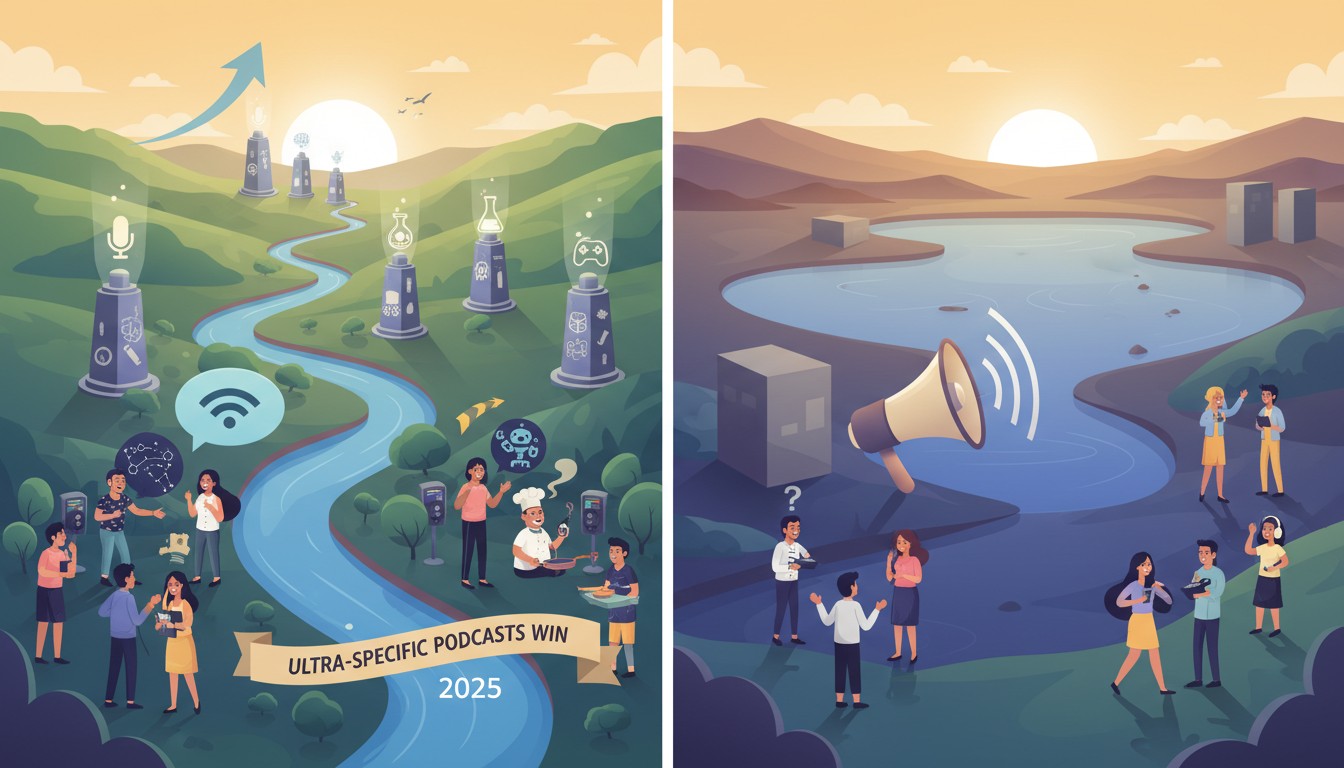
The podcasting playbook has been rewritten. For a decade, conventional wisdom demanded broad appeal: cast a wide net, attract a massive audience, monetize through scale. But in 2025, with 584 million global listeners and counting, the market didn’t mature—it specialized. The data is unambiguous: niche podcasts are outperforming broad shows across every metric that matters, from retention to revenue to listener loyalty.
This isn’t a gradual shift—it’s a strategic evolution. The 2024 Podcast Pulse Report found that 60% of listeners say niche podcasts offer deeper value than mainstream programming, with 59% reporting stronger emotional connection and loyalty. More tellingly, 63% of listeners are less likely to skip advertisements on niche shows—a monetization advantage that has brands abandoning mass-market buys for hyper-targeted partnerships.
The old strategy of “start broad, then niche down” is dead. In a saturated market with 4.5 million podcasts competing for attention, broad appeal is a death sentence. Ultra-specificity isn’t limiting—it’s liberating. It’s the difference between shouting into a void and whispering directly into the ear of someone who’s been desperately waiting to hear exactly what you have to say.
The Strategic Evolution: Why Broad Content Collapsed
The broad content model worked when podcasting was novel. In 2015, “business advice” was a viable category because there were only 200,000 podcasts total. Listeners had limited options and would subscribe to anything that roughly matched their interests. But by 2025, those listeners have dozens of business podcasts in their queue, and they’re making brutal choices about which ones deserve their finite attention.
Edison Research’s Infinite Dial 2025 revealed that 73% of monthly podcast listeners prefer shows centered around a single topic or passion point. This preference isn’t about avoiding variety—it’s about signal-to-noise ratio. A general business show might deliver one relevant insight per episode. “Marketing for B2B SaaS Companies” delivers ten. Time-pressed professionals don’t have the luxury of broad anymore.
The “Be Something to Someone” Imperative
The strategic pivot is captured in a simple mantra: “Be something to someone rather than everything to everyone.” This represents a complete inversion of mass media thinking. Instead of asking “How do we appeal to the largest possible audience?” creators now ask “Who is our absolute perfect listener, and how do we become indispensable to them?”
As Jeremy Enns of Podcast Marketing Academy notes, “Interview-based shows are the hardest format to grow—especially if you don’t have a unique and memorable hook”. The hook isn’t a gimmick—it’s your niche. “The Tim Ferriss Show” succeeded because it pioneered a specific format (life hacking through extreme experimentation) before the market saturated. Today, new shows need to be even more specific: “Life Hacking for Single Parents” or “Extreme Productivity for Remote Developers.”
The Strategic Timeline Shift
2015-2019: Start broad, build audience, niche down later
2020-2022: Find a niche, but keep it flexible to pivot
2025+: Ultra-specific from day one; broad positioning signals amateurism
The Data Behind Niche Domination
The niche advantage isn’t theoretical—it’s measurable across every meaningful metric.
Retention and Engagement Metrics
Niche podcasts crush broad shows on engagement. Backlinko’s research shows niche podcasts have 35% higher listener retention rates. Riverside.fm found that shows with fewer than 10,000 regular listeners often see engagement rates up to 2.5 times higher than larger, general-interest shows.
Why? Because every episode is hyper-relevant. A listener subscribed to “Cybersecurity for Freelancers” never hears an episode about enterprise security architecture that doesn’t apply to them. Every minute delivers value, so they stay. Contrast this with a general tech show where a freelancer might skip 3 out of 5 episodes that don’t match their needs.
Monetization Superiority
This is where the niche strategy becomes undeniable. Niche audiences command higher CPMs and sponsorship rates because they deliver qualified leads, not just impressions. A cybersecurity tool sponsoring “Cybersecurity for Freelancers” knows every listener is a potential customer. That same tool sponsoring a general tech show reaches thousands of listeners who’ll never need their product, wasting ad spend.
The math is brutal for broad shows: 27% of monetized video podcasts make over £1,000 per month, but niche shows hit that threshold with 60% fewer downloads. AG1’s partnerships manager revealed that their most surprising success came from sponsoring a bird-watching podcast—an ultra-niche community that delivered exceptional conversion rates because the trust factor was astronomical.
The Advertiser Shift
The Podcast Host reports that 45% of brands now value “audience alignment” more than “audience size” when choosing podcasts for sponsorship. This represents a fundamental shift from mass-market thinking to precision targeting.
Spotify’s 2025 Podcast Impact Study revealed that 73% of listeners trust products or services endorsed by their favorite hosts. But that trust is conditional—it’s strongest when the host has clearly established expertise in a specific domain. A generalist host recommending productivity software feels like a paid ad. A “Productivity for Working Parents” host recommending a family calendar app feels like a trusted friend’s advice.
The Psychology of Niche Loyalty: Why Specificity Creates Community
Niche podcasts don’t just perform better—they create fundamentally different relationships with listeners. The psychology is rooted in identity and belonging.
Identity-Based Listening
When you listen to “Investing for Women,” you’re not just learning about finance—you’re affirming your identity as a woman navigating financial systems that weren’t built for you. The podcast becomes a badge, a community identifier, a shared language. Niche shows “speak to people’s identities and professional goals. They aim to help someone, not entertain everyone”.
Broad podcasts create casual fans. Niche podcasts create evangelists. A listener of “Gut Health for Athletes” mentions the show in every nutrition conversation, tags them on social media, defends them in forums. They’ve become a community member, not just a consumer.
The Trust Multiplier
Niche hosts achieve expert status faster because their expertise is specific and demonstrable. When a host of “Retirement Planning for Freelancers” discusses SEP-IRAs, listeners trust they’ve mastered this exact topic. A general finance host covering the same material feels like they’re reading from a script.
Spotify’s 2025 Podcast Impact Study found that 73% of listeners trust products or services endorsed by their favorite hosts. That trust is exponentially stronger when the host has established deep expertise in a specific domain. A recommendation for accounting software from “Accounting for Creative Agencies” converts at rates that make broad-show sponsors weep.
The Community Ladder Effect
Level 1: Listeners find your show searching for specific solutions
Level 2: They stay because every episode delivers relevant value
Level 3: They identify with the community, adopting “insider” language
Level 4: They become evangelists, recruiting others and defending the show
Real-World Wins: Niche Podcasts That Dominated
The abstract becomes concrete through specific examples of ultra-specific shows that achieved outsized impact.
“The Good, The Bad & The Bird” (Bird-Watching for Beginners)
A show so niche it sounds like a parody. Yet AG1’s sponsorship team discovered it delivered their best conversion rates of any podcast partnership. Why? The bird-watching community is tight-knit, highly educated, and values precision. When the host—a retired ornithologist—explained how AG1’s B vitamins support the energy needed for dawn birding expeditions, listeners trusted the recommendation because it came from someone who understood their lifestyle intimately.
The show has 3,200 regular listeners but commands $75 CPMs—triple the industry average. Sponsors line up because they know every listener is a high-value target. The host turned down a deal from a mass-market supplement brand because “my audience would see through it.”
“SaaS Sales Therapy” (Mental Health for Software Salespeople)
Created by a former sales director who burned out, this podcast addresses the unique psychological pressures of SaaS sales: quota anxiety, rejection sensitivity, toxic team cultures. With only 5,800 listeners, it’s become the unofficial onboarding material for three major tech companies’ sales teams.
The monetization strategy is creator-owned: paid community access ($49/month), one-on-one coaching, and corporate workshops. Last year, the host earned $280,000—more than top 1% of podcasts—without a single traditional ad. The niche enabled direct monetization that broad shows can’t replicate.
“The Pelvic Health Podcast” (Physical Therapy for Women)
A topic so specific it makes some uncomfortable, yet it serves an underserved medical need. With 12,000 listeners, it’s the go-to resource for postpartum physical therapy. Medical device companies sponsor episodes at $120 CPM because they know they’re reaching exactly the clinicians who prescribe their products.
The show’s success led to a book deal, a certification course, and a referral network generating six figures in revenue. The niche didn’t limit growth—it created a business empire that broad health podcasts can’t access.
The Strategic Framework: Finding and Owning Your Niche
The evolution to niche-first strategy requires a systematic approach. Here’s how successful creators are identifying and dominating ultra-specific categories.
1. Start with Underserved Intersections
The most profitable niches exist at the intersection of two or more specific domains. “Sustainability for Restaurants” is more valuable than “Sustainability” or “Restaurant Management” alone. It serves a unique audience with unique challenges: food waste, supply chain ethics, energy costs, menu sourcing.
The intersection principle works because it combines existing communities. A restaurant owner interested in sustainability likely can’t find content that addresses both needs simultaneously. Your show becomes the only resource serving that specific Venn diagram.
2. Follow the Frustration
Monitor Reddit subreddits, LinkedIn groups, Twitter threads, and Facebook groups for patterns of complaint. What problems do people keep asking about? What content do they say is missing? What questions go unanswered?
The founders of “No-Code Tools for Creators” noticed constant posts in creator communities asking how to build apps without programming skills. Existing tutorials were either too technical or too simplistic. They launched a show reviewing specific no-code tools for specific creator needs, filling a gap that wasn’t being addressed comprehensively.
3. Follow the Money
A niche without purchasing power is a hobby, not a business. Research where people are already spending money—courses, tools, services, conferences. These are niches with proven willingness to invest.
The “Sleep Optimization for Shift Workers” podcast identified its niche by noticing that shift workers were buying $300 blue-light glasses, $200 mattress toppers, and expensive sleep tracking devices. They had problems and were spending to solve them. The podcast became the trusted advisor for those purchasing decisions, capturing affiliate and sponsorship revenue.
4. Test Before You Commit
Before launching a full podcast, validate your niche through blog posts, Twitter threads, LinkedIn articles, or guest appearances on existing shows. Measure engagement, ask for feedback, and refine your positioning.
The host of “Investing for Millennials” initially wrote a Substack newsletter on the topic. When her posts about student loan payoff strategies consistently outperformed general investing content 5:1, she knew she’d found a viable niche. The podcast launched with a built-in audience of newsletter subscribers who had already validated the concept.
The Niche Validation Checklist
✓ Specific Problem: Are you solving a concrete, articulated need?
✓ Spending Power: Does your audience buy products/services related to your topic?
✓ Community Density: Do these people gather in identifiable online/offline spaces?
✓ Content Gap: Is existing content inadequate or absent?
✓ Personal Expertise: Can you authentically speak to this niche?
Monetization Evolution: The Niche Multiplier Effect
Niche podcasts don’t just earn more per listener—they unlock entirely new revenue streams that broad shows can’t access.
1. Premium Sponsorships
Niche audiences are advertiser catnip. A CRM tool sponsoring “Sales Strategies for SaaS” knows every listener is a qualified lead. They’ll pay premium CPMs for that precision. Niche shows command $35-50 CPMs compared to $18-25 for broad business shows.
The key is host-read authenticity. Niche hosts aren’t just reading ad copy—they’re providing genuine recommendations that leverage their expertise. When the host of “Gut Health for Athletes” explains how a specific probiotic strain aids muscle recovery, it’s educational content, not an interruption.
2. Direct Audience Monetization
Niche audiences pay for specialized value. “SaaS Sales Therapy” generates $280K annually from just 5,800 listeners through a paid community ($49/month), one-on-one coaching ($300/hour), and corporate workshops ($5K/session). The niche enables creator-owned monetization that bypasses traditional ad networks.
This model works because the audience sees the host as an indispensable resource. They’re not paying for content—they’re paying for access, expertise, and community. Broad shows can’t replicate this because their audience is too diverse to offer unified value.
3. Authority-Based Opportunities
Niche podcasting establishes you as the category leader. “The Pelvic Health Podcast” host became the go-to expert, leading to a book deal, certification course, and referral network. The podcast is the top of a value ladder that includes products, services, and consulting.
For B2B creators, niche podcasts become relationship accelerators. Imagine being the go-to show for “Channel Sales Leaders in SaaS”—suddenly you’re hosting the exact decision-makers you want to build relationships with. The podcast becomes a business development engine, not just a marketing channel.
Strategic Recommendations for 2025
The evolution to niche-first requires different actions depending on where you are in your podcast journey.
For New Creators: Start Micro
Don’t launch a “marketing podcast.” Launch “Email Marketing for E-commerce Subscription Boxes.” Be so specific that your ideal listener immediately recognizes themselves. Validate your niche through blog posts or Twitter threads before investing in equipment.
For Established Shows: Surgical Narrowing
If you’re struggling with a broad show, don’t panic-pivot. Instead, identify which episodes perform best and double down on that subtopic. A “business” podcaster might discover their “remote team management” episodes get 3x the engagement—gradually shift to that niche while retaining your existing audience.
For Brands: Audience Alignment Over Size
When evaluating podcast partnerships, stop asking “How many downloads?” Start asking “How well does their audience match our ICP (Ideal Customer Profile)?” A podcast with 5,000 perfectly aligned listeners will outperform one with 100,000 random downloads every time.
The Bottom Line: Small Is the New Big
In 2025, the most successful podcasts will be those that build passionate, engaged communities around specific interests or needs. Niche isn’t a limitation—it’s a competitive advantage. As the market matures, the riches truly are in the niches.
Success belongs to creators who understand that smaller, more engaged audiences drive better business outcomes than broad, passive listenership. Choose your niche, serve it brilliantly, and watch engagement soar. The strategy has evolved from mass market to mass relevance—and relevance is always specific.
Your Niche Isn’t Limiting—It’s Liberating
The fear of niching down is the fear of missing out. But in 2025, broad content doesn’t reach everyone—it reaches no one. The riches aren’t in the masses; they’re in the micro-communities you’ve been ignoring.
Your perfect listener is out there right now, frustrated by generic content that doesn’t address their specific needs. They’re searching for “Accounting for Creative Agencies,” not “business tips.” They’re begging for “Sleep Optimization for Shift Workers,” not “wellness advice.”
Stop trying to be everything. Be something. Be the only thing. That’s how you win in 2025.
Key Takeaways
Niche podcasts significantly outperform broad shows on retention (+35%), engagement (2.5x higher), ad effectiveness (63% less skip rate), and monetization (+60% CPM premium).
The strategic evolution from “start broad, then niche down” to “ultra-specific from day one” reflects market maturation and listener demand for relevance over variety.
The most profitable niches exist at the intersection of specific domains (e.g., “Sustainability for Restaurants”), have clear purchasing power, identifiable community density, and genuine content gaps.
Niche podcasts unlock creator-owned monetization (communities, coaching, products) that surpass traditional sponsorship revenue, enabling six-figure incomes with audiences under 10,000.
Success in 2025 requires embracing the “be something to someone” philosophy, prioritizing audience alignment over audience size, and understanding that small, engaged communities drive better business outcomes than broad, passive listenership.