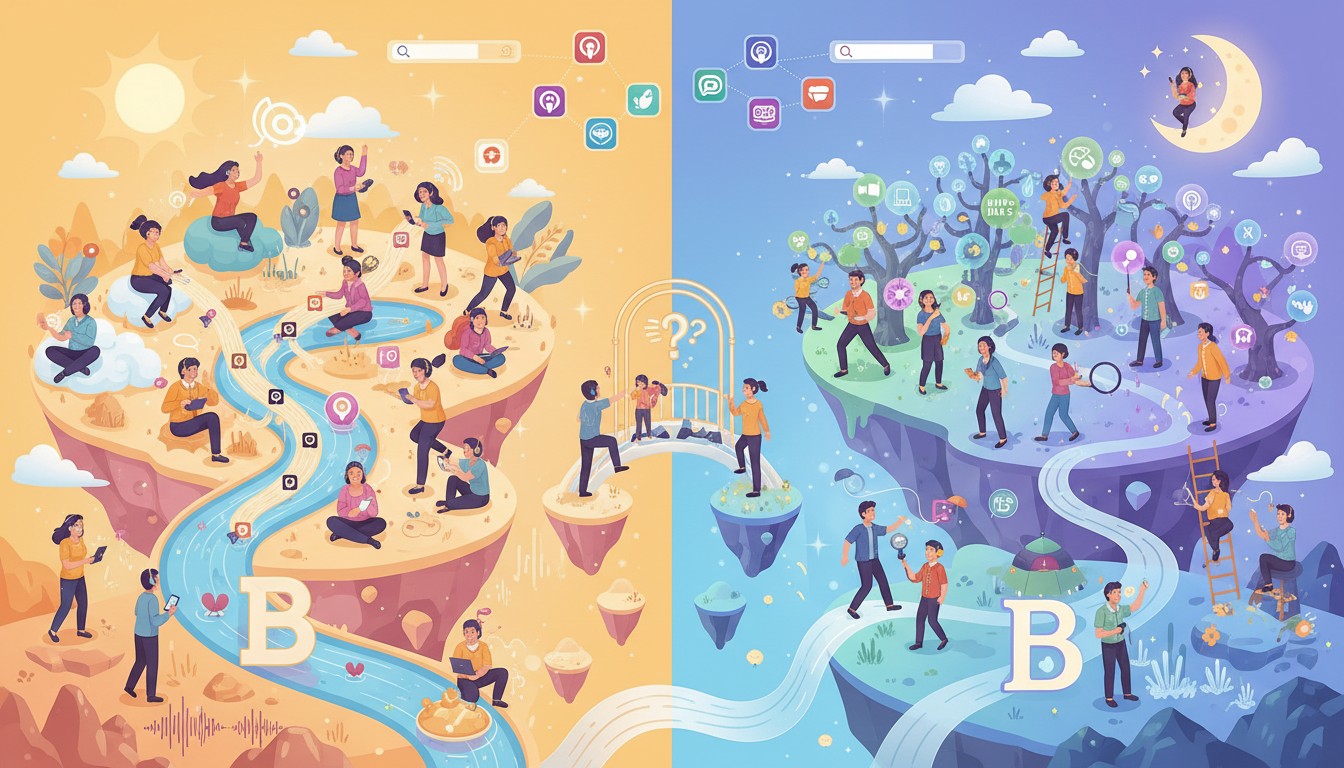
The way people find podcasts has fractured into two distinct behaviors with completely different psychological triggers, platform dependencies, and loyalty patterns. According to 2024 survey data from The Podcast Host, 50% of listeners discover new shows through their preferred podcast app, yet when asked how they actually found their last listened podcast, only 19% credited app browsing. The rest came through social media (16%), podcast cross-promotion (14.5%), and personal recommendations (26% combined). We’re swimming in discovery channels, but most creators are fishing in the wrong pools.
This bifurcation creates a strategic nightmare. The “binge discoverer” wants infinite content suggestions, trusts algorithms, and samples impulsively. The “browse discoverer” wants curated lists, trusts human reviewers, and researches methodically. Optimize for one and you alienate the other. Understanding this divide—and learning to serve both—transforms your show from a hidden gem into a discoverable destination.
The Invisible Architecture: How Platforms Program Discovery
Podcast discovery isn’t a free market of ideas—it’s a curated garden where platforms decide which paths are paved and which are left wild. The architecture of apps like Spotify, Apple Podcasts, and YouTube doesn’t just facilitate discovery; it fundamentally shapes what listeners find and how they find it.
The binge-centric design dominates most major platforms. Academic analysis of Podimo’s recommendation system reveals that 87% of listening sessions begin with the “recall section”—the top row showing recently played or suggested shows based on prior behavior. The algorithm isn’t designed to introduce you to something new; it’s designed to keep you moving through familiar territory. This creates a feedback loop where “discovery” is really just algorithmic drift within your existing interest cluster.
Conversely, browse-centric discovery thrives on YouTube and TikTok, where search and social sharing dominate. Transistor’s 2025 Gen Z survey found that 46% of listeners aged 15-29 use YouTube as their primary podcast platform, with 80% discovering new podcasts through their TikTok feeds. These platforms prioritize content that can be sampled in 30-60 second clips, creating a “browse-to-binge” pipeline where a short clip hooks the viewer, who then seeks out the full episode.
Platform Discovery Architecture: Designed for Different Behaviors
Binge Platforms (Spotify, Apple Podcasts): Autoplay, algorithmic recommendations, episode queuing, genre-based rows that reinforce existing habits
Browse Platforms (YouTube, TikTok, Google): Search-first interfaces, trending pages, creator cross-promotion, shareable clips, comment-driven discovery
Hybrid Platforms (Patreon, Substack): Creator-led discovery, community recommendations, direct-to-audience promotion
The Discovery Gap: Only 3% of listeners find podcasts through platform algorithms, despite 50% starting their search in apps—revealing algorithmic failure to surface novel content
The Psychology of Discovery: Two Brains, One Medium
The binge vs browse divide isn’t just behavioral—it’s neurological. Binge discovery activates the brain’s reward-seeking dopamine system, creating pleasure from continuous novelty. Browse discovery activates the deliberative prefrontal cortex, seeking value and fit. Most listeners toggle between both modes, but their dominant behavior determines which discovery triggers work on them.
The Binge Brain: Hooked on Novelty
Binge discoverers are the podcast ecosystem’s power users. SiriusXM Media’s research reveals that 83% found a new show in the last six months, and 60% finish entire series within the first week of release. They listen to podcasts like Netflix episodes—back-to-back, often at 1.5x speed, consuming 7+ hours weekly. Their discovery is driven by momentum: the algorithm suggests, they sample, and if the hook lands within 30 seconds, they’re in for the long haul.
This behavior creates specific discovery pathways. Binge listeners trust autoplay suggestions 3x more than search results. They discover through “listeners also subscribed” features and cross-episode guest appearances. They’re 63% more likely to gravitate toward miniseries and limited releases that promise a complete narrative arc. For them, discovery isn’t a search—it’s a continuous flow.
The Browse Brain: Trust in Curation
Browse discoverers approach podcasts like book buying. They read descriptions, scan reviews, check episode titles for patterns, and often listen to the first 2-3 minutes before committing. The Podcast Host’s survey found that 70% of app-based discovery happens through topic searches, and the #1 reason they hit play is a good description. They’re not looking for what’s next—they’re looking for what’s right.
This group discovers through Google searches (5.5%), social media recommendations (33%), and word-of-mouth (33%). They trust human curators more than algorithms and are 2.5x more likely to subscribe based on a friend’s suggestion than an autoplay suggestion. They’re also more patient with older content—88% don’t mind listening to episodes created months ago, unlike binge listeners who prioritize freshness.
The Gen Z Disruption: Browse-to-Binge Pipeline
Gen Z doesn’t choose between binge and browse—they sequence them. Edison Research’s Gen Z Audio Report shows 63% aged 13-24 listen monthly, discovering primarily through YouTube (46%) and TikTok (80% of TikTok users found new podcasts on the platform). They browse short clips, then binge full episodes. If you’re not creating shareable video excerpts, you’re invisible to this generation.
Real-World Discovery Paths: How Shows Actually Get Found
The statistics tell the macro story, but individual shows reveal the micro-mechanisms. These anonymized trajectories from creator forums illustrate how discovery patterns play out in practice.
The Algorithmic Drift Discovery
A listener finishes episode 200 of “The Daily” on Spotify. Autoplay queues a similar news podcast they’ve never heard of. They listen for 3 minutes, find it competent, and let it continue. By episode 4 of this new show, they’re hooked. They’ve never searched for it, never read a review, never consciously decided to subscribe. The algorithm bridged the gap between “what I know” and “what’s next.” This is pure binge discovery—serendipity through automation.
The TikTok-to-Podcast Pipeline
A Gen Z user scrolls TikTok, sees a 45-second clip of a podcaster making a provocative point about relationships. The caption says “full ep link in bio.” They click, land on YouTube, watch the full 45-minute episode, then immediately subscribe. They discovered through social browsing but converted to binge behavior. CoHost Podcasting’s data shows 55% of TikTok users are active on the platform specifically to discover new things, making it the ultimate browse-to-binge engine.
The Friend-Who-Knows-Me Discovery
A professional mentions they’re struggling with public speaking. A colleague texts them a link to a specific episode of “The Speaker’s Lab” with the note: “This helped me.” They listen, find it useful, then download three more episodes on different topics. This is pure browse behavior—human-curated, need-based, and review-free. The trust in the recommender substitutes for all other signals.
The Compound Effect: Discovery Creates Discovery
Podcast discovery operates on a compound model where each new listener increases your discoverability exponentially. The mechanism is simple: when someone subscribes, their podcast app begins recommending your show to that person’s network. When they share on social media, the algorithm surfaces your content to similar users. When they mention you in another podcast, you inherit their audience’s trust.
This creates a tipping point around 1,000 subscribers. Below that threshold, discovery is linear and manual—you grind for each new listener. Above it, discovery becomes exponential—the platforms’ algorithms start working for you. Riverside.fm’s 2025 data shows that 55% of listeners get recommendations from people they know, meaning each loyal subscriber becomes a micro-influencer for your show.
The key is to engineer this compound effect by serving both discovery types simultaneously. Create binge-ready content (consistent format, serial arcs, autoplay-friendly) while maintaining browse-friendly signals (strong SEO, shareable clips, clear positioning). This dual optimization creates a flywheel: browse discoverers find you through search and shares, binge discoverers find you through their apps, and both feed the algorithm with engagement data that surfaces you to more listeners.
The Discovery Flywheel: How Momentum Builds
Stage 1 (0-100 subscribers): Manual outreach, social sharing, guest appearances—pure hustle
Stage 2 (100-1,000 subscribers): Algorithmic recommendations begin; cross-promotion with similar-sized shows
Stage 3 (1,000-5,000 subscribers): Autoplay discovery kicks in; listeners become advocates; platform charts notice
Stage 4 (5,000+ subscribers): Exponential growth; each episode feeds the algorithm; discovery becomes self-sustaining
The multiplier: At each stage, serving both binge and browse behaviors accelerates transition to the next
Practical Strategies: Optimizing for Both Discovery Types
Serving both binge and browse discoverers requires intentional design choices that feel contradictory but are actually complementary. The goal is to create a show that’s both algorithm-friendly and human-recommendable.
Create “Hook-Dense” Opening Minutes
Binge listeners decide in 30-60 seconds whether to continue; browse listeners decide in 2-3 minutes whether to subscribe. Your opening must satisfy both: start with a compelling question, startling statistic, or provocative statement. Then within 90 seconds, deliver clear value that makes the browse listener feel smart for choosing you. This isn’t about clickbait—it’s about front-loading the promise you intend to keep.
Design for “Clipability”
Every episode should contain at least one 30-60 second segment that can stand alone as a TikTok, Reel, or YouTube Short. Headliner data shows video clips earn 1200% more shares than text, and Gen Z discovers 80% of new podcasts through TikTok. This doesn’t require video equipment—use Headliner or Descript to create audiograms with animated waveforms and captions. Make browse content that converts to binge behavior.
Build a “Discovery Funnel” with Episode Titles
Your episode titles should work like SEO for browse listeners and like metadata for binge algorithms. Use clear, searchable keywords that solve specific problems: “How to Negotiate Salary (3 Scripts That Work)” satisfies the Google searcher while signaling to algorithms exactly who needs this content. Avoid vague, clever titles that require context—browse listeners skip them, and algorithms can’t categorize them.
Engineer Cross-Promotion Opportunities
Guest on shows with similar audiences, but don’t stop there. Create “podcast swap” episodes where you and another host exchange short segments. This serves binge discovery (autoplay suggests the crossover) and browse discovery (listeners trust recommendations within episodes they already enjoy). Podnews research shows that 13% of listeners discover new shows through other podcasts, making this the third-highest discovery method.
The Dual-Optimization Checklist
For Binge Discoverers: Consistent release schedule, serial arcs, autoplay-friendly format, guest crossovers, miniseries
For Browse Discoverers: SEO-optimized titles, shareable clips, clear show description, social proof, time-stamped links
Both Benefit From: High audio quality, compelling first 90 seconds, clear value proposition, consistent branding
Discovery Is a Mirror, Not a Map
The binge vs browse dilemma isn’t a problem to solve—it’s a reality to embrace. Your audience doesn’t discover podcasts the way you wish they would. They discover them the way their brains are wired, their platforms are designed, and their habits are formed.
Stop asking “How do I get discovered?” and start asking “How do I make discovery inevitable for both types of listeners?” The answer isn’t choosing between algorithmic optimization and human connection—it’s building a show that serves both. A podcast that’s easy to find, impossible to forget, and effortless to share.
Your next listener is either about to fall down a rabbit hole or methodically compare options. Build a show that’s worthy of both journeys. That’s how you turn discovery into inevitability—and inevitability into a show that lasts.
Key Takeaways
Podcast discovery has bifurcated into binge behavior (algorithmic, impulsive) and browse behavior (curated, methodical), requiring different optimization strategies.
50% of listeners start discovery in podcast apps, but only 19% actually find shows there—most discovery happens via social media (16%), cross-promotion (14.5%), and word-of-mouth (33%).
Gen Z has merged both patterns: they browse short-form clips on TikTok/YouTube, then binge full episodes, making video excerpt creation essential for reaching this demographic.
Discovery operates on a compound model: each new subscriber increases algorithmic recommendations, creating a tipping point around 1,000 subscribers where growth becomes exponential.
Successful creators serve both discovery types by creating hook-dense openings, “clipable” segments, SEO-optimized titles, and engineered cross-promotion opportunities.