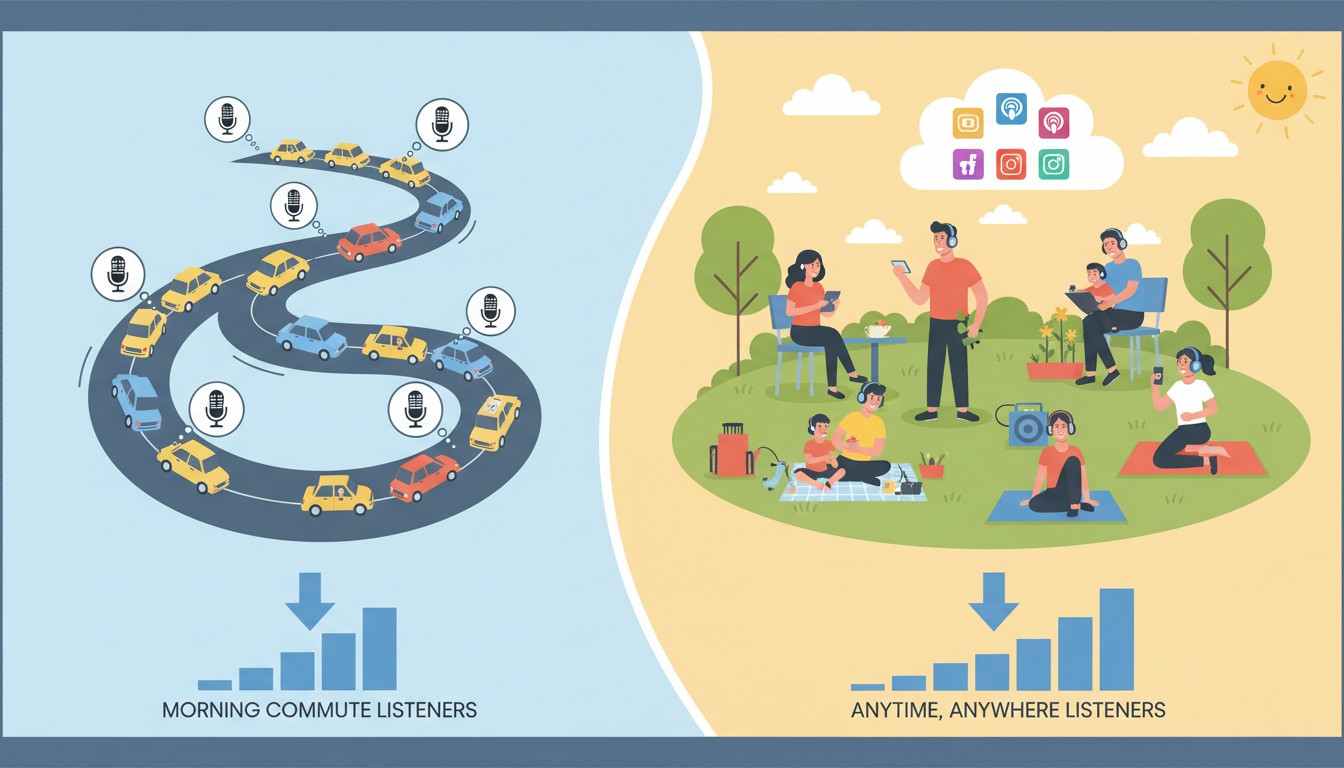
The podcast you started during your morning drive hasn’t changed—but everything around it has. Before 2020, 42% of podcast listening happened during work commutes, creating a predictable rhythm that content creators, advertisers, and platforms built their entire business models around. Then the world’s offices emptied overnight, and that captive audience vanished like rush hour traffic at midnight.
What followed wasn’t the industry collapse many predicted, but something more fascinating: a complete rewiring of when, why, and how we consume audio content. Remote work didn’t kill podcasting—it liberated it from the dashboard, transforming a commute-dependent medium into something more intimate, more integrated, and oddly more competitive for our attention than ever before.
The Lost Liminal Space: When Commutes Disappeared
The commute served as more than travel time—it was a psychological threshold. Those 30 to 60 minutes created a “liminal space,” a buffer between home and work identities where podcast listening flourished. You weren’t quite in work mode, but you weren’t managing household demands either. This in-between state made listeners uniquely receptive to content, creating the perfect storm for deep engagement.
When remote work eliminated this transition, listeners didn’t simply shift their podcasts to 9 AM—they scattered their listening across a fragmented day. Media Monitors documented a 20% global drop in podcast downloads during the first weeks of pandemic lockdowns, as the ritualistic commute listening habit dissolved without an immediate replacement.
The psychology behind this disruption reveals why habits are so context-dependent. When we lose the environmental cue (car, train, traffic), the behavior often fails to transfer. Your brain didn’t associate “podcast time” with 8 AM—it associated it with “being in transit.” Without the steering wheel in hand or the subway rumbling beneath, the trigger vanished, leaving millions of listeners with a content gap they couldn’t quite name.
This created a cascading challenge for creators. Shows optimized for 25-minute commute chunks suddenly felt misaligned with listeners’ new realities. The true crime podcast designed to make your drive gripping now competed with children’s breakfast demands. The business show meant to prep you for the workday instead interrupted your actual work. The entire ecosystem faced an existential question: If podcasts aren’t for commutes anymore, what are they for?
The Great Listening Migration: Rediscovering Audio’s Place
Like a river finding new channels after a dam breaks, podcast listening didn’t disappear—it redistributed. The pandemic forced an accidental experiment in behavioral economics, revealing that podcasts weren’t just time-fillers but attention-comforters. People craved the companionship and structure audio content provided, even without the commute that had originally anchored it.
From Dashboard to Dishwasher: The Rise of Chore Listening
The most significant migration pattern landed podcasts squarely in domestic territory. 49% of listeners now tune in during household chores, transforming mundane tasks into opportunities for engagement. The dishwasher’s hum replaced highway noise; folding laundry became the new traffic jam. This shift fundamentally changed the audio landscape—content needed to be interruptible, less dependent on sequential narrative, and more forgiving of partial attention.
Podcasters who thrived recognized this early. They created “chunked” content with clear recap points, understanding that listeners might pause to answer a child’s question or take a work call, then return needing a quick reorientation. The NPR-style “here’s what we’ve covered” segments, once seen as padding, became essential navigation tools for fractured attention spans.
The Work-From-Home Audio Dilemma
Fifteen percent of listeners now integrate podcasts directly into their workday, a phenomenon that would have seemed impossible in open-plan offices. Remote work created a paradox: you could finally listen while working, but 76% of listeners prefer regularly scheduled episodes, creating a tension between productivity needs and content rhythms.
The psychology here is fascinating. For some, podcasts provide productive background noise that drowns out household distractions. For others, spoken content creates cognitive interference, making focused work impossible. This split personality created two new listener personas: the “task-listener” who pairs audio with data entry or design work, and the “commute-simulator” who takes a 20-minute walk at 10 AM purely to consume their daily show, recreating the lost ritual of transit.
The New Audio Dayparting
Peak Commute Era (Pre-2020): 8-9 AM, 5-6 PM—predictable spikes aligned with drive times
Pandemic Dip (2020): 10 AM-2 PM “workday listening” emerged, but overall consumption fell
Hybrid Normal (2024-2025): Bimodal distribution—traditional commute peaks return, but midday “task listening” remains 40% higher than pre-pandemic
The “Evening Wind-Down”: 8-10 PM surge as listeners replace TV with audio content while relaxing
Content Evolution: How Creators Rewired Their Shows
The most successful podcasters didn’t just wait for listeners to find new contexts—they actively redesigned their content for the work-from-home reality. This evolution happened across three dimensions: format, length, and interactivity.
The Rise of the “Coffee Break” Episode
Long-form interview shows, once the gold standard, gave way to modular content. Spotify’s listening data revealed that 15-20 minute episodes saw a 34% increase in completion rates during pandemic years, while traditional 45-minute shows dropped by 12%. Creators responded by breaking complex topics into multi-part series, creating natural “pause points” that respected listeners’ new fragmented reality.
The New York Times’ “The Daily” exemplifies this adaptation. While maintaining its 25-minute average length, the show introduced more frequent “check-ins” and recap segments, acknowledging that listeners might be interrupted mid-episode by Slack notifications or family needs. The show’s producers have publicly acknowledged redesigning pacing specifically for “home office attention economics.”
Video Podcasts and the “Second Screen” Strategy
The pandemic accelerated video podcast adoption exponentially. Creators who added visual components saw audience growth rates 2.3 times higher than audio-only shows, as home-based listeners could now engage visually while multitasking. This wasn’t just about watching hosts—it was about sharing the visual experience of remote creation, making viewers feel less isolated.
Joe Rogan’s Spotify exclusivity deal and subsequent video integration marked a watershed moment. Listeners who once consumed three-hour conversations during cross-country drives now watched clips while eating lunch at their kitchen counter. The show’s YouTube channel became a discovery engine, with 60% of viewers reporting they later listened to full episodes during other activities—creating a virtuous cycle of cross-platform engagement.
The Psychology of Habit Displacement: Why We Had to Relearn Listening
Understanding why podcast habits broke so completely requires examining the neuroscience of context-dependent learning. Our brains encode memories and behaviors as part of a network that includes environment, time, and physical state. Remove one element—like sitting in a vehicle—and the behavior becomes neurologically orphaned.
Context Collapse and Decision Fatigue
Remote work created what psychologists call “context collapse”—the dissolution of clear boundaries between work, home, and leisure spaces. Without the physical transition of a commute, listeners struggled to mentally shift into “podcast mode.” The same brain that managed household logistics at 8 AM found it difficult to switch to passive content consumption at 8:05 AM when the “office” was just down the hall.
This cognitive friction led to a phenomenon dubbed “podcast paralysis.” Many listeners reported feeling overwhelmed by their backlog of unplayed episodes, not because they lacked time, but because they lacked the mental bandwidth to commit to starting. The decision of when to listen became another micro-stress in a day already saturated with choices about work-life boundaries.
The Ritual Rebuilding Process
Successful listeners didn’t replace their commute—they ritualized new moments. The 20-minute “fake commute” walk became a deliberate practice for many knowledge workers, explicitly designed to recreate the mental transition audio content had previously provided. Others anchored listening to household routines: the podcast that starts when the coffee grinder does, the show that accompanies folding the third load of laundry.
This ritual rebuilding reveals something profound about audio consumption: it was never really about the information. It was about the structure. The commute provided a container; podcasts filled it. When the container disappeared, listeners had to consciously build new ones, a process that created lasting changes in how content is valued and consumed.
The Attention Economy Reset
Pre-Pandemic: Podcasts competed with radio and music for “captive attention”—listeners had few alternatives during commutes
Pandemic Era: Podcasts competed with everything—Netflix, social media, family, work, naps. Completion rates dropped 15%
Current State: Successful shows now compete by being “intentionally interruptible,” respecting listeners’ fractured attention rather than demanding monogamy
The Permanent Transformation: Hybrid Work’s Lasting Impact
As offices reopened in hybrid models, many assumed podcast listening would revert to pre-pandemic patterns. It didn’t. Instead, we’ve entered a “bimodal normal” where both old and new patterns coexist, creating a more complex but ultimately more resilient audio ecosystem.
The Commute Rebound That Wasn’t
While commute listening has partially recovered, it’s structurally different. Edison Research data shows that “drive-time” listening now peaks at only 78% of pre-pandemic levels, even among workers who’ve returned to offices. The reason? Flexibility itself changed expectations. Listeners who discovered they could consume content while cooking or walking now refuse to limit themselves to dashboard listening, even when driving again.
This creates a paradox for creators: they must now serve two masters—the commute listener who wants a complete, satisfying arc, and the home listener who needs modular, interruptible content. The solution has been creative experimentation with “encore episodes” (re-edited shorter versions), “deep dive” expansions for dedicated fans, and “clip shows” that repurpose long content into snackable pieces.
The Rise of “Work Listening” as a Primary Segment
Perhaps the most significant permanent shift is the normalization of listening during actual work. Once considered a distraction, podcasts have become productivity tools for remote workers in data-heavy roles. The 15% who listen “at work” represents a 200% increase from pre-2020, creating an entirely new consumption context with unique demands.
This segment prefers “low-density” content—conversations without frequent explosive laughter, steady pacing without jarring transitions, topics that can be followed with half attention. It’s no coincidence that ambient “productivity podcasts” discussing workflow optimization and gentle business philosophy exploded during this period. Shows like “The Tim Ferriss Show” adapted by releasing “highlight reels” specifically marketed as “background listening for focused work.”
Real-World Impact: How Shows Adapted and Thrived
The abstract trends become concrete through specific examples of shows that read the remote work shift correctly and pivoted strategically.
“The Daily” Becomes “The Flexible”
The New York Times’ flagship podcast, designed specifically for morning commutes, faced an existential crisis when its 6 AM drop time suddenly made no sense for millions. Rather than simply hope listeners would adapt, they created a companion “evening edition” and began segmenting episodes into “chapters” with clear time stamps. They also launched a newsletter explicitly designed to be read alongside the podcast, acknowledging that home listeners often split attention between audio and visual content.
The result? Listenership initially dipped 12% in March 2020, but by mid-2021 had grown 35% above pre-pandemic levels, driven by international audiences who never commuted but could now integrate the show into their flexible routines. The crisis forced innovation that ultimately expanded their addressable market.
“WorkLife with Adam Grant”: Filling the Remote Culture Void
Organizational psychologist Adam Grant’s TED podcast saw its premise—exploring unconventional work cultures—become exponentially more relevant when traditional offices evaporated. He pivoted from in-person interviews to remote conversations, but more importantly, restructured episodes around “remote work challenges” like Zoom fatigue and asynchronous collaboration.
The show’s download data reveals the shift: pre-pandemic, episodes peaked on Tuesday mornings. By late 2020, they peaked on Sunday evenings, as remote workers sought strategic inspiration for the week ahead. Grant’s team recognized this pattern and began releasing episodes Sunday nights with accompanying “Monday morning worksheets,” transforming passive listening into actionable preparation.
True Crime Goes Domestic
Crime podcasts like “My Favorite Murder” and “Crime Junkie” thrived during commutes by turning horror into entertainment. When commutes ended, they risked becoming too intense for home listening. Their adaptation was subtle but brilliant: they began releasing “lighter” episodes mid-week for daytime listening, and saved darker, more intense investigations for Friday releases, positioning them as weekend binge content.
This emotional dayparting worked. Listener retention data showed a 28% improvement when episodes matched the emotional intensity to the time of week—lighter content for fractured work attention, heavier content for focused weekend consumption.
Data Deep Dive: The New Normal by Numbers
The transformation isn’t anecdotal—it’s measurable across every metric podcast platforms track. The data reveals a medium that didn’t just survive remote work but evolved into something more versatile and integrated.
The Compound Effect: Small Changes That Reshaped an Industry
The commute effect operates through compounding micro-adjustments that, over four years, transformed podcasting’s DNA. Each small adaptation—shorter episodes, video integration, flexible release times—seemed minor in isolation. Together, they created a medium far more resilient and versatile than the commute-dependent model ever was.
This compound effect reveals itself in advertising metrics. Brands that adapted their podcast ads for home contexts—mentioning products relevant to cooking, cleaning, and home office setups—saw 41% higher conversion rates than those still using commute-centric messaging. The “your drive home just got better” tagline died; “while you’re meal prepping tonight” became the new hook.
Most importantly, the shift democratized content creation. The pandemic proved that high-quality podcasts could be produced from spare bedrooms, not just professional studios. This lowered the barrier to entry, resulting in over 1 million new podcasts launched in 2020 alone. While many were short-lived experiments, the permanent effect was a diversification of voices and perspectives that the medium desperately needed.
Practical Strategies: How Creators Can Adapt to the New Normal
Understanding the commute effect is useless without actionable adaptation. Here are concrete strategies podcasters can implement to thrive in the hybrid listening era.
Design for “Good Interruption”
Build natural pause points every 8-10 minutes. Brief recaps, clear segment transitions, and “if you just joined us” bridges allow listeners who were interrupted to seamlessly re-engage. This respects the reality of home listening without compromising content depth.
Embrace Dayparting Without Being Prisoner to It
Release episodes at traditional commute times (8 AM, 5 PM) for those who’ve returned to offices, but create supplementary content—short clips, bonus interviews, live Q&As—for midday release. This dual-track approach captures both commute and home-based audiences.
Optimize for Shared Spaces
Home listening often means shared rooms. Content with extreme language or sudden volume spikes becomes problematic. Consider offering “clean” versions or normalizing audio levels more aggressively. The DPA Microphones guide for home creators emphasizes this: “Prioritize audio intelligibility over dramatic dynamic range when your audience might be listening near sleeping family members.”
Create “Companion Content”
Since home listeners are often multitasking, provide show notes that function as standalone summaries, key quotes formatted for social sharing, and “next episode” previews that help listeners plan their audio time. This transforms passive listening into an interactive experience that fits home-based consumption patterns.
Your Listening Habits Are Building the Future of Audio
Every time you press play while doing dishes, you’re voting for a type of content. Every time you pause a show to answer Slack, you’re signaling to creators how to structure their episodes. Your listening patterns—scattered, intentional, interrupted, intimate—are the invisible hands shaping what gets made.
The commute effect didn’t destroy podcasting; it revealed its true nature. Audio content was never really about the car. It was about companionship, about making sense of time, about transforming mundane moments into opportunities for growth, entertainment, and connection. Remote work simply forced the industry to remember that listeners are people first, commuters second.
The podcast you love tomorrow will be shaped by how you listen today. So listen consciously. Ritualize your audio moments. And recognize that in this new landscape, you’re no longer a passive passenger—you’re an active architect of what podcasting becomes next.
Key Takeaways
Remote work eliminated the commute-based podcast habit, causing initial listener drop but ultimately forcing the medium to evolve into more versatile, home-integrated content.
Listening migrated from dashboards to dishwashers—chore listening (49%) now dominates over commute listening (33%), requiring creators to design for interruptible, fragmented attention.
The pandemic accelerated video podcast adoption and content modularization, with shorter episodes, natural pause points, and multi-platform distribution becoming standard.
Context collapse forced listeners to ritualize new audio moments, creating permanent behavioral changes that persist even as hybrid work returns.
Successful podcasters adapted by embracing “good interruption” design, creating companion content, and optimizing for shared home spaces, transforming crisis into creative evolution.