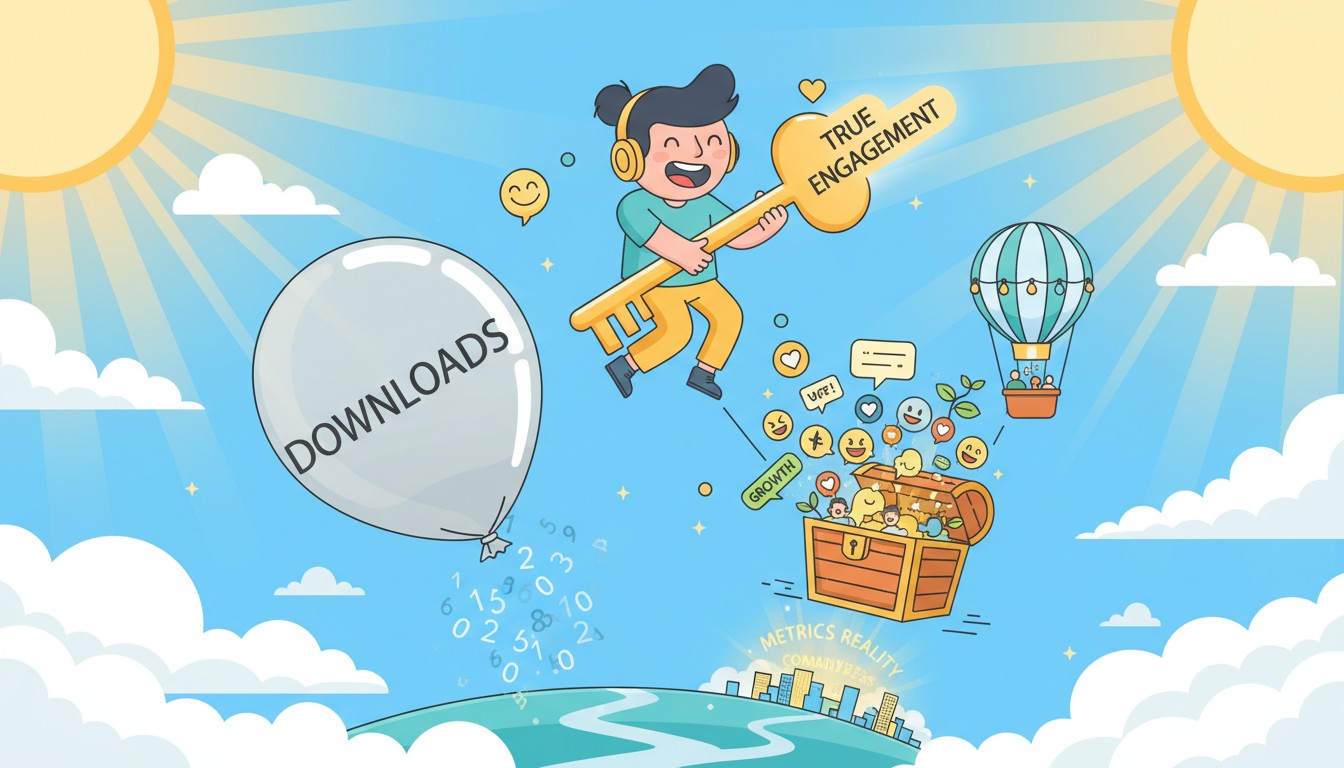
The podcast industry runs on a number that means almost nothing. In 2025, as global podcast revenue reaches $3.94-4.95 billion annually, the entire ecosystem still measures success through downloads—a metric invented in the RSS era of 2004, designed to count file requests, not human attention. Research from media analytics reveals that up to 60% of podcast downloads never result in a single second of actual listening, while the average completion rate for episodes hovers at a sobering 30-40%.
This isn’t a technical footnote—it’s a psychological crisis. Creators obsess over numbers that measure server activity while ignoring metrics that capture human connection. The download is the original sin of podcasting: a convenient lie that feels objective but masks profound ignorance about what actually happens after the file lands on a device. Understanding the illusion requires examining not just how these numbers are generated, but why we cling to them despite their hollowness.
The Ghost in the Machine: How Downloads Became Meaningless
The podcast download is a technical artifact, not a behavioral one. When your RSS feed pings a subscriber’s podcast app, the app automatically downloads the episode file—often in the background, sometimes multiple times if the transfer fails, frequently to a device that never plays it. As one industry analysis brutally states, “There are lies, damned lies, and podcast download statistics.” The number is inflated by:
– **Automatic downloads**: Many apps prefetch episodes, triggering server requests that count as “listens” even if the user never consciously chose to download
– **Bot scrapers**: RSS feeds are constantly crawled by bots, search engines, and archiving services
– **Multi-device duplication**: The same person may download an episode on their phone, tablet, and laptop—counting as three unique “listeners”
– **Partial plays**: A download that results in 30 seconds of listening before abandonment counts the same as one heard to completion
The IAB Podcast Measurement Guidelines attempted to create standards, but adoption is voluntary and enforcement is non-existent. Two podcasters with identical “5,000 download” episodes might have actual audiences of 500 and 3,000 engaged listeners—and there’s no way for sponsors to tell the difference from the outside.
The Overestimation Epidemic
This measurement chaos leads to rampant—and often unconscious—overestimation. The podcast industry report from Podcast Industry Statistics reveals that industry size estimates vary wildly, from $2B to $20B annually, because no one can accurately measure consumption. The $4.95B figure used in their analysis is an attempt at transparency, but even that assumes downloads ≈ value, which the data doesn’t support.
When platforms like Spotify report “40% of users listen to podcasts,” they’re counting anyone who clicked play for one second. When creators celebrate “10,000 downloads,” they’re toasting phantom listeners. The entire ecosystem operates on a shared delusion because the alternative—admitting we don’t know who actually listens—is commercially unpalatable.
The Download Deconstruction: Where Your Numbers Actually Come From
Real Human Listeners: 40-50% (actual people who pressed play)
Automatic Downloads: 25-30% (apps downloading in background)
Bot Traffic: 10-15% (scrapers, archivers, spammers)
Duplicate Devices: 10-20% (same listener, multiple downloads)
Bottom Line: Your 5,000 downloads = 2,000-2,500 actual listeners *if you’re lucky*
The Metrics Mirage: What Gets Measured Gets Manipulated
The obsession with downloads creates perverse incentives. Creators optimize for the metric they can see, not the impact they want to create. This leads to:
Title Clickbait & Thumbnail Deception
You craft sensational episode titles that spike downloads but disappoint listeners, creating a bounce rate (podcast term: “abandonment rate”) that damages long-term growth. The short-term dopamine hit of a download spike masks the slow erosion of trust. Brands evaluating your show see high downloads but low completion rates and reject you—audience does not equal success if that audience is constantly disappointed.
The Length Paradox
Industry wisdom says “longer episodes = more downloads” because loyal subscribers count for each release. But completion rates for 90-minute episodes often drop below 20%, while focused 20-minute shows regularly hit 70-80%. You’re optimizing for a vanity metric (total downloads) while destroying the engagement metric (completion rate) that actually predicts sponsor conversions and listener loyalty.
The Cross-Promotion Trap
You appear on another podcast, they appear on yours, and both shows get a temporary download bump from curious listeners who subscribe, download your back-catalog, and never listen again. Your subscriber count grows but your average completion rate collapses. You’ve expanded your phantom audience, not your real one.
The Hidden Metrics That Actually Matter
If downloads are the illusion, what constitutes reality? The metrics that matter are harder to measure but impossible to fake:
Completion Rate: The Attention Gold Standard
How many people listen to at least 75% of your episode? This single metric predicts everything that matters: sponsor conversion, word-of-mouth growth, listener loyalty. A show with 1,000 downloads and 70% completion has a more valuable audience than one with 5,000 downloads and 20% completion. The math is simple: 700 engaged listeners > 1,000 casual ones.
Yet most creators can’t easily access this data. Apple Podcasts Connect buries it three clicks deep. Spotify for Creators shows it but doesn’t explain how to improve it. The metrics that matter are hidden while the metrics that lie are featured prominently. This isn’t accidental—platforms want you optimizing for downloads because downloads make their ecosystems look bigger.
Listener Action Rate: The Conversion Signal
When you recommend a book, how many buy it? When you share a promo code, how many use it? This is the only metric sponsors ultimately care about, yet it’s nearly impossible to track at scale. Smart creators build proprietary tracking: unique landing pages, affiliate links, post-purchase surveys. They know that a 3% conversion rate among 500 true fans beats a 0.1% rate among 5,000 phantom listeners.
Community Depth: The Un-Gameable Metric
How many listeners email you thoughtful responses? How many show up to live events? How many defend you from trolls? This depth can’t be faked or bought. It grows slowly and organically, which is why creators ignore it in favor of the quick dopamine hit of download spikes. But depth predicts longevity while downloads predict nothing.
The True Success Metrics Dashboard
Engagement Rate: (Downloads × Completion Rate) ÷ Total Downloads = Real Audience
Action Rate: Promo code uses ÷ Downloads × 100 = Sponsor Value
Community Velocity: Organic mentions, emails, event attendance = Longevity
Sustainability Index: Time invested ÷ Joy derived = Burnout Risk
Reality Check: If you track only one metric, track completion rate. Everything else is noise.
The Mental Health Toll: Living by Lies
The download illusion doesn’t just mislead sponsors—it destroys creators. When you tie your self-worth to a number that doesn’t reflect reality, you build a house of cards in an earthquake. The dopamine crash when downloads plateau is real and devastating, but it’s based on a fiction. You haven’t failed; the metric has failed you.
The Comparison Death Spiral
You see a peer’s viral episode hit 50,000 downloads and question your entire endeavor. What you don’t see: their completion rate is 15% because the clickbait title delivered disappointment. They’re not successful—they’re just louder. The industry’s overestimation problem means everyone is comparing themselves to inflated numbers, creating a collective anxiety disorder where no one feels adequate despite creating meaningful work.
The Burnout Accelerator
Chasing download growth demands increased output: longer episodes, more frequent releases, cross-promotion hustles. But engagement—the metric that matters—actually improves with focus and restraint. The 30-minute weekly show with 70% completion beats the 90-minute daily show with 20% completion, but creators choose the latter because downloads look better on a media kit. This is how the illusion kills creativity: by rewarding the wrong behavior.
The Mental Health Diagnostic
Do you check downloads multiple times per day? = Metric dependency
Do you feel anxious when downloads plateau? = Self-worth externalization
Do you compare your numbers to others weekly? = Comparison compulsion
Do you sacrifice quality for release frequency? = Optimization obsession
Score: 3+ “yes” answers indicates the download illusion is harming your wellbeing
Breaking the Illusion: How to Measure What Actually Matters
Recovery requires abandoning the metric that comforts you for the metrics that serve you. This isn’t about ignoring data—it’s about measuring the right things.
Step 1: Implement Real Tracking
Use tools like Podtrac or Chartable to get IAB-certified metrics, but supplement them with:
– **Unique listener IDs**: Track individual devices, not downloads
– **Timestamp analysis**: See where listeners actually stop listening
– **Survey-based audience data**: Ask listeners directly about behavior
– **Conversion tracking**: Build unique URLs for every call-to-action
Present this data to sponsors. They’ll value your transparency and precision more than inflated download numbers.
Step 2: Set Process Goals, Not Outcome Goals
Instead of “reach 10,000 downloads,” set goals like “improve completion rate by 5% through better editing” or “receive 10 meaningful listener emails per month.” These are within your control and measure real impact. When you hit them, the satisfaction is genuine, not algorithmic.
Step 3: Practice Metric Fasting
Take one full week per month where you don’t check analytics at all. Use the freed mental energy to create something purely for joy—a bonus episode, an experimental format, a personal story with no SEO value. Reconnect with why you started. The download illusion loses its power when you regularly step outside it.
Your Success Can’t Be Counted
The download illusion persists because it’s simple. It’s one number that fits in a tweet, a media kit, a pitch deck. It lets you compare yourself to others, track “progress,” and feel productive. But it’s a lie—a convenient fiction that measures server activity, not human connection, possibility, not impact.
Real success in podcasting is the email from a listener saying your episode got them through chemotherapy. It’s the community that forms around your show without your prompting. It’s the sponsor who renews because your audience actually buys, not because your download count is high. These things can’t be counted, but they can be felt. They can be built. They can be trusted.
Stop refreshing. Start creating. Measure what matters, even if it doesn’t fit in a spreadsheet. The downloads will always be an illusion. Your impact never will be.
Key Takeaways
Downloads are a technical artifact measuring server requests, not human attention—up to 60% never result in listening, making them a misleading success metric.
Industry revenue estimates ($3.94-4.95B) are built on download-based assumptions that overstate market size and creator earnings.
Completion rate, listener action rate, and community depth are the true indicators of podcast success, but they’re harder to measure and often ignored.
The download illusion creates perverse incentives for clickbait, overproduction, and burnout while rewarding the wrong creative behaviors.
Creators must implement real tracking, set process-based goals, and practice metric fasting to break free from the psychological trap of download obsession.