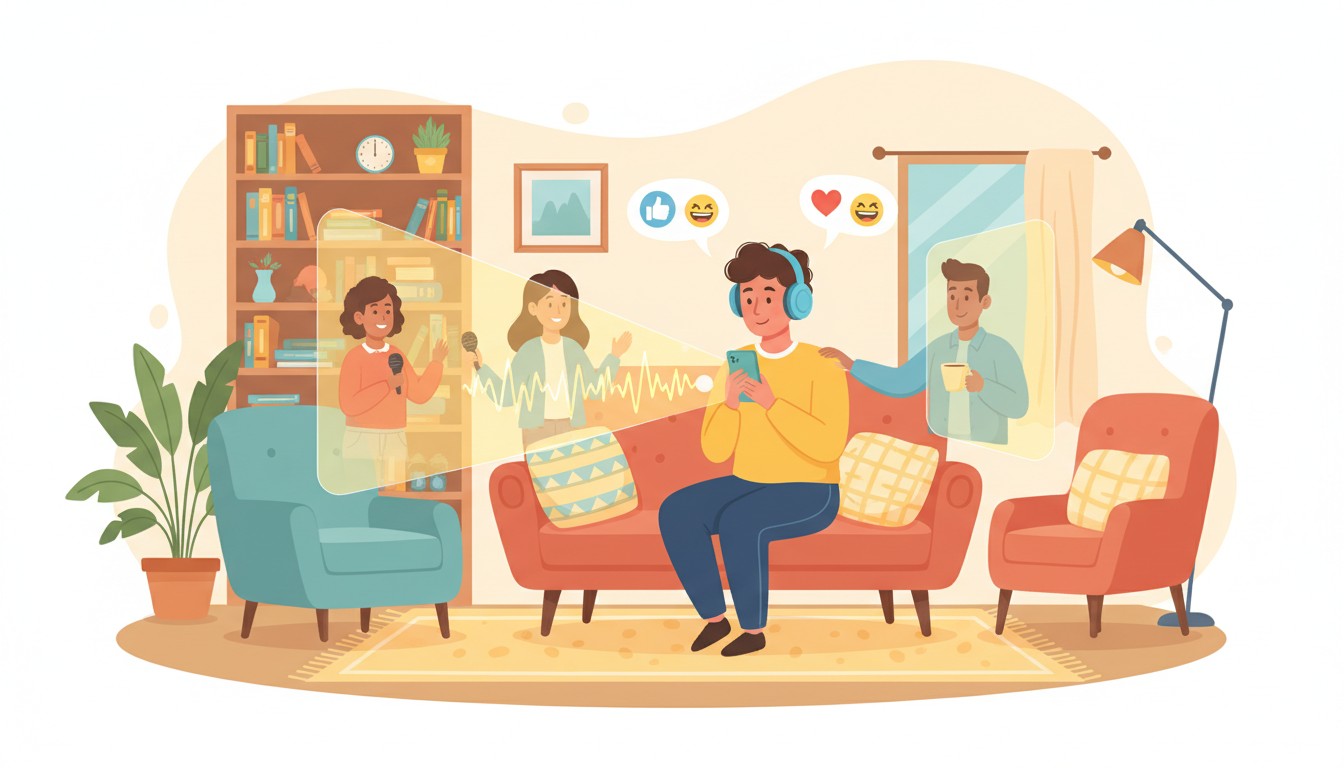
The voices that accompany us through our most mundane and vulnerable moments aren’t physically present—they’re beamed through tiny speakers directly into our brains. Yet research from media psychology studies shows that over 70% of regular podcast listeners report feeling “genuinely connected” to hosts they’ve never met, with 40% admitting they’ve cried during an episode. In 2025, as podcast listenership reaches 584 million people globally, these one-sided relationships are reshaping how we define connection, community, and even friendship itself.
This emotional bond isn’t accidental—it’s engineered by the medium’s unique architecture. Podcasts create what researchers call parasocial relationships: intense, intimate connections that feel mutual but exist entirely in the listener’s mind. While television and radio pioneered this phenomenon in the 1950s, podcasts have perfected it, transforming passive audiences into devoted communities who show up for live shows, defend creators from criticism, and trust their recommendations more than those of real-life friends.
The Architecture of Artificial Intimacy: How Podcasts Hack Your Brain
Every element of podcast design—from audio-only delivery to release schedules—serves to deepen the illusion of friendship. Unlike video, which reminds you of the distance between you and the screen, audio collapses space. The voice enters your ear canal, creating what neuroscientists call “proximal presence,” the same neural mechanism that helps mothers bond with infants through lullabies.
Headphones amplify this effect by eliminating environmental cues. When you listen through earbuds, the voice bypasses your auditory cortex’s spatial processing and activates the same regions that process face-to-face conversation. You don’t just hear them—you feel them. This explains why parasocial relationships coined in the television era have evolved into something far more potent in the podcasting age.
The ritualistic nature of podcast consumption cements this bond. Listeners report listening during highly personal moments: 66% while commuting, 62% while exercising, and 38% while driving—these are periods of solitude where real friends might be unavailable. But the podcast host is always there, consistent as a sunrise, delivering content directly to you. Unlike social media’s performative highlight reels, podcasts traffic in vulnerability, imperfection, and confession—hallmarks of authentic friendship.
The Intimacy Multipliers: What Makes Podcasts Different
Audio-Only Format: Eliminates visual distance, creating direct neural pathways for emotional connection
Long-Form Content: Average episode length of 30-60 minutes mimics real conversations, building trust through sustained presence
Consistency: Weekly releases trigger habit formation, making hosts feel like reliable fixtures in listeners’ lives
Perceived Spontaneity: Unscripted moments and “ums” signal authenticity, making hosts feel more “real” than polished media personalities
RSS Independence: Direct download creates sense of personal delivery, bypassing algorithmic intermediaries
The Psychology of One-Sided Bonds: Why Your Brain Believes the Lie
Parasocial relationships aren’t inherently pathological—they served an evolutionary purpose. Our ancestors formed bonds with tribal storytellers who shared wisdom around fires. The brain doesn’t distinguish between a voice that responds and one that simply continues talking. When a host shares a personal failure, your mirror neurons fire as if a friend were confiding in you. The oxytocin release is real, even if the relationship is not.
A 2025 study published in the Journal of Radio & Audio Media identified specific authenticity markers that trigger parasocial bonding: spontaneous laughter, self-deprecating humor, admissions of uncertainty, and behind-the-scenes glimpses of imperfect lives. These “flaws” function as intimacy accelerators, making hosts seem accessible rather than aspirational.
The University of Queensland research found that **time spent listening** is the single strongest predictor of parasocial relationship strength. Every hour invested deepens the illusion. Binge-listening to a 50-episode back catalog in a week creates a compressed friendship timeline that feels like years of shared history. This explains why podcast fans exhibit loyalty metrics that shame other media—over 70% finish most or all of each episode, compared to the 3-second average watch time on social media videos.
The Authenticity Paradox: Real Enough to Trust, Fake Enough to Control
Here’s the subtle manipulation: hosts appear authentic while maintaining complete narrative control. They edit out the boring parts, the arguments, the days when they’re irritable or uninteresting. Listeners receive a curated “greatest hits” version of a personality, never experiencing the friction that defines real relationships. This creates an impossible standard—your actual friends have bad days, but your podcast friend is always witty, insightful, and available.
This dynamic becomes problematic when listeners begin prioritizing parasocial connections over reciprocal ones. Mental health professionals report increasing cases of clients who feel more understood by podcast hosts than by their partners, yet can’t articulate why these relationships feel so meaningful. The answer lies in the lack of risk—podcast friends can’t reject you, judge you, or disappoint you in unpredictable ways. They’re safe.
The Creator’s Dilemma: When Your Fake Friends Become Real Revenue
Podcasters walk a tightrope between leveraging intimacy and maintaining ethical boundaries. The illusion of intimacy directly drives monetization. Listeners use sponsor codes at rates that shame traditional advertising—one survey found 75% of female listeners take action after hearing podcast ads. Patreon supporters contribute monthly not for content, but for the feeling of supporting a friend. This transactional element introduces a moral hazard: creators profit from bonds that can’t exist reciprocally.
Successful podcasters develop strategies to manage this dynamic. Some explicitly acknowledge the parasocial nature, using humor to puncture the illusion: “I know you think we’re best friends, but I’m literally talking to a microphone in my closet.” Others create artificial reciprocity through Q&A episodes, voicemails, and “shout-outs” that simulate conversation. The most ethical creators set clear boundaries, refusing to share certain personal details and redirecting emotional labor to mental health professionals rather than their audience.
The Monetization Paradox
Paradox: The more “authentic” and vulnerable a host appears, the more listeners trust them
Result: Higher conversion rates on sponsor codes and Patreon subscriptions
Ethical Risk: Incentivizing performers to fabricate or exaggerate vulnerability for profit
Warning Sign: When personal tragedy becomes a “content strategy” rather than an organic moment
Solution: Transparent disclosure of sponsored content and clear boundaries about what won’t be shared
Real-World Impact: When Illusion Creates Community—and Chaos
The intimacy illusion produces both profound connection and dangerous entitlement. On the positive side, parasocial bonds have created support networks that transcend geography. A mental health podcast’s Facebook group becomes a 24/7 crisis support community where listeners help each other because they share the host’s values. Fans of a parenting podcast organize meal trains for members undergoing chemotherapy, bonded by the host’s philosophy of “village parenting.”
The Dark Side: When Listeners Become Stalkers
The same intensity that builds community can weaponize. A true crime podcaster shared her P.O. Box for fan mail; within months, a listener appeared at her home, convinced their “friendship” meant she wanted to meet in person. Another host who discussed her divorce received hundreds of messages judging her dating choices, with listeners feeling entitled to weigh in on her personal life. The line between intimacy and intrusion dissolves when the illusion becomes too convincing.
Most commonly, creators face the “friendship tax”—listeners demanding emotional labor via DMs, expecting responses to personal questions, or becoming angry when the host’s real-life choices contradict the persona they’ve created. A podcaster who mentioned she was considering moving cities faced backlash from fans who felt “betrayed” that she would leave the community they’d imagined sharing with her.
The Algorithmic Amplification Effect
YouTube’s dominance in podcast distribution (33% of weekly listeners) introduces new risks. The platform’s recommendation algorithm reinforces parasocial intensity by serving more of the same, creating echo chambers where the host’s worldview becomes the listener’s primary reality. A comedy podcast fan who watches clips daily will see those hosts’ takes amplified across their entire feed, making the parasocial relationship feel even more central to their social world.
Practical Strategies: Healthy Engagement in the Parasocial Age
The intimacy illusion isn’t going away—it’s built into the medium. But both listeners and creators can develop practices to keep these relationships healthy and productive rather than delusional and exploitative.
For Listeners: Recognize the Architecture
Start by naming the dynamic. When you catch yourself thinking “she’d love my idea” or “he really gets me,” pause. Remind yourself: *I am experiencing a carefully crafted illusion.* This isn’t cynicism—it’s critical consciousness. Acknowledge the real emotions while recognizing their one-sided nature.
Set consumption boundaries. If you listen to a podcast every day during a vulnerable moment (before sleep, during anxiety), the host becomes associated with emotional regulation. This is risky. Diversify your emotional support system. Ensure you’re spending more time in reciprocal relationships than parasocial ones. The rule: for every hour of podcast listening, invest two hours in actual conversation.
For Creators: Ethical Intimacy
Transparency is your ethical obligation. Periodically remind your audience: “We don’t actually know each other.” This feels counterintuitive—it might reduce short-term engagement but builds long-term trust. The hosts who last decades aren’t those who maximize exploitation of the illusion, but those who maintain sustainable boundaries.
Create explicit structures for community, not cults. Redirect personal DMs to public forums where listeners help each other. When you share personal struggles, also share your support system: “I’m in therapy, talking to my actual friends, not just processing this on the mic.” Model healthy boundaries.
The Reality Check Protocol
Weekly Intimacy Audit
Listeners: Track how often you reference podcast hosts in conversations. If you’re saying “my friend [host name]” more than once a week, you need reality anchors.
Creators: Review DMs for entitlement patterns. If 10% of messages demand personal responses, it’s time for a boundary-setting episode.
Both: Ask: Would this dynamic work if the microphone turned off? If not, it’s parasocial, not social.
The Test: Send a message to a real friend every time you feel tempted to DM a host. Invest in reciprocity.
The Future of Fake Friendship: Where Do We Go From Here?
As the podcast industry projects toward $25 billion in revenue by 2030, the intimacy illusion will only intensify. AI-generated voices will soon create customizable hosts who address listeners by name, referencing their specific circumstances. The line between parasocial and personal will blur further. We’re heading toward a world where everyone has a “friend” in their headphones, perfectly calibrated to their interests, always available, never disappointing.
This isn’t inherently dystopian. Parasocial relationships can provide genuine comfort, reduce loneliness, and introduce us to perspectives we’d never encounter in our geographic bubble. The danger lies not in the illusion itself, but in our failure to recognize it. When we mistake curated content for reciprocal relationship, we disinvest from the messy, disappointing, beautiful reality of actual human connection.
Your Voice Is Real, Even If Theirs Isn’t
The voices in your headphones feel real because they are—real recordings of real people sharing real thoughts. Your emotional response is genuine. Your sense of connection is valid. But it’s also one-sided, curated, and fundamentally different from friendship.
The intimacy illusion isn’t a bug in podcasting—it’s the feature that makes the medium so powerful. But power without awareness becomes manipulation, whether self-inflicted or monetized by creators. The most important voice in this dynamic isn’t the one coming through your earbuds—it’s the one inside your head that reminds you: this feeling is real, but this relationship is not.
You can love the voices that accompany you through your days. Just make sure the people who can actually hear you—who show up when you’re sick, who call back, who disagree and forgive and forget—get more of your time, energy, and heart. The podcast will play whether you’re listening or not. Real friends won’t. Choose accordingly.
Key Takeaways
Parasocial relationships in podcasting are amplified by audio-only formats, headphone use, and routine integration, creating powerful one-sided bonds that feel mutual.
Time spent listening is the strongest predictor of parasocial intensity, with authenticity markers like vulnerability and imperfection accelerating the illusion.
The intimacy illusion drives podcast monetization but creates ethical risks, including boundary violations, emotional exploitation, and community entitlement.
Both listeners and creators can practice healthy engagement through transparency, boundary-setting, and conscious investment in reciprocal relationships.
The future of podcasting will intensify these dynamics, making critical awareness of parasocial relationships essential for mental health and authentic connection.