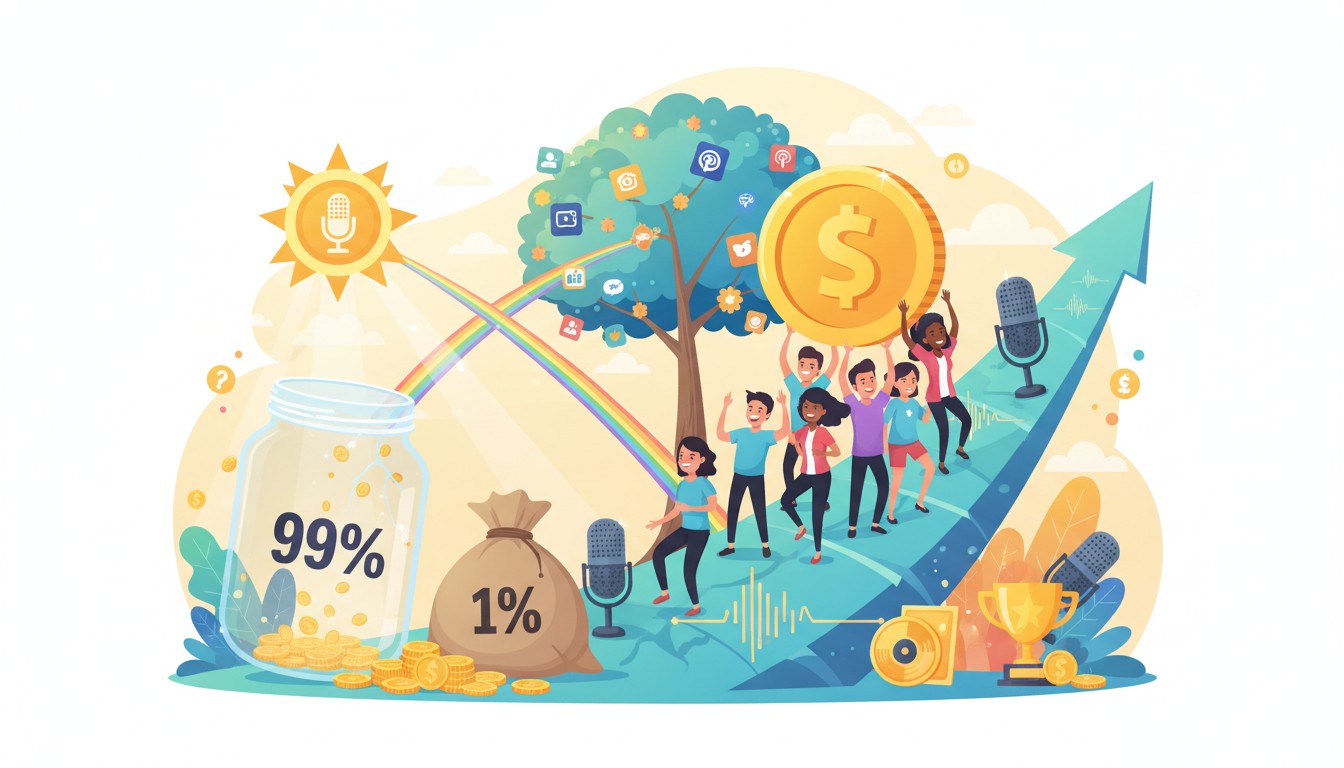
The podcast industry is booming—if you’re measuring by corporate valuations. With the market projected to reach $17.59 billion by 2030 and ad spending hitting $4.46 billion in 2025, the narrative writes itself: there’s gold in them thar headphones. But dig into the data and a darker picture emerges. While Spotify and iHeartMedia celebrate record profits, the individual creator economy is a ghost town of abandoned feeds, dead RSS links, and creators who’ve invested thousands to earn pennies.
The podcast money myth persists because it’s powered by survivorship bias on steroids. We see Joe Rogan signing nine-figure deals, hear about podcasters landing five-figure sponsorships, and watch creators build media empires from their closets. What we don’t see are the 4.6 million other podcasts competing for the same scraps. The brutal math reveals a truth no equipment sponsor wants to admit: if your show gets 25 downloads in its first week, you’re already in the top 50% of all podcasters. Not the top 50% of earners—the top 50% of shows that exist at all.
The 99% Reality: Hard Numbers on an Impossible Dream
Let’s start with the most damning statistic: 99% of podcasts don’t make it past episode 10. This isn’t because creators lack passion—it’s because the economics collapse immediately. After investing $500-$2,000 in equipment, $10-$50 monthly in hosting, and countless hours in production, most shows earn exactly zero dollars. Forever.
The industry revenue breakdown reveals why. The total global podcast market generates an estimated $3.94-4.95 billion annually—but 76% of that comes from advertising, which flows almost exclusively to the top 1% of shows. Direct listener support, the great hope of indie creators, accounts for just $400-450 million total. Put another way: Patreon paid podcasters $350 million in 2023, but with 4.6 million shows competing, the average annual haul is less than $80 per podcast—barely enough to cover two months of hosting fees.
The Revenue Iceberg: What You See vs. Reality
Visible Tip (1% of Shows): $50K-500K+ per episode in ad revenue
Middle Tier (4% of Shows): $500-5,000 per episode, mostly breaking even
Hidden Mass (95% of Shows): $0-100 per episode, operating at significant loss
Bottom Line: 584 million listeners, but ad revenue goes to the top 0.01% who have scale
The Economics That Don’t Work: Why Ad Models Fail at Small Scale
The podcast ad model is brutally simple: advertisers pay on a CPM (cost per thousand) basis, with rates ranging from $10-$50 per thousand downloads. This means a show with 1,000 downloads per episode—a respectable achievement that puts you in the top 10% of podcasts—earns $10-$50 per episode if they monetize 100% of their inventory. After accounting for hosting costs ($20/month), equipment depreciation ($50/month), and time investment (20 hours at minimum wage = $200), you’re operating at a net loss of 400-800%.
The math gets worse. Most shows can’t sell 100% of their ad slots. A typical indie podcast sells 30-40% of inventory, meaning that 1,000-download show actually earns $3-$20 per episode. To reach a poverty-level income of $20,000/year, you’d need 10,000 downloads per episode with 100% sell-through—and that would still require 1,000+ hours of annual work, effectively paying you $20/hour before taxes.
This is why the advice to “wait for sponsors” is economically suicidal. As one industry expert notes, “Unless you have massive downloads (we’re talking 50,000+ per episode) or incredible niche authority where brands are already seeking you out, sponsors aren’t going to magically discover your show.” The sponsorship model works for iHeart’s 68.9 million monthly listeners. It doesn’t work for your 500 loyal fans.
The Hosting Platform Paradox: Paying to Be Ignored
The podcast ecosystem is built on a cruel irony: creators pay platforms to host content that platforms use to attract advertisers. Libsyn charges creators $20+/month while earning $32.7 million annually from hosting revenue . Acast takes in $17.3 million from podcasters while simultaneously controlling access to ad networks . Spotify for Creators (formerly Anchor) offers “free” hosting but takes a 30% cut of any listener support and controls your distribution.
These platforms profit whether you earn or not. In fact, they profit more when you don’t earn—because broke creators keep paying monthly fees hoping for a breakthrough that never comes. The economics are stark: podcast hosting alone generates $100-150 million annually, while direct listener support—the supposed solution to ad dependency—totals just $400-450 million . For every dollar a listener gives directly to creators, platforms extract 25-30 cents in processing fees.
The Hidden Cost Infrastructure: Paying to Play in a Rigged Game
The podcast industrial complex extracts money from creators at every stage. The equipment trap is first: you “need” a $300 microphone, $200 in acoustic treatment, $100 in cables, and $50 in pop filters. The equipment market generates $285-300 million annually —all paid by creators, not earned by them. The industry tells you this is an “investment,” but it’s a forced buy-in to a lottery where 99% lose.
Then comes the software stack: editing software ($100/year), transcription services ($10/episode), analytics tools ($20/month), and recording platforms ($25/month). The software category extracts another $100-150 million annually from creators . Each tool promises to “professionalize” your show, but they primarily professionalize your expenses.
The time investment is the real killer. A single episode requires 4-6 hours of work: research (1hr), recording (1hr), editing (2-3hrs), show notes (1hr), promotion (1hr). At 47 episodes and counting, you’ve invested 200-300 hours. At minimum wage ($7.25), that’s $1,450-$2,175 in uncompensated labor. Your $4.27 in Spotify revenue represents a 0.19% return on your time investment.
The Burnout Equation: When Passion Becomes Exploitation
Most podcasters ignore monetization until it’s too late because they’re told to “focus on audience first” . This advice serves the platforms—not creators. By the time you realize your audience of 500 devoted listeners will never generate ad revenue, you’ve already invested hundreds of hours and thousands of dollars. The psychological cost is devastating: resentment toward your passion project, shame about “failure,” and the creeping suspicion that you were duped.
As one creator candidly admits: “Forever, 99% of podcasts don’t make a penny from their shows. It’s just a fact, never do this for money you will be greatly disappointed” . The burnout isn’t from hard work—it’s from working hard in a system designed to extract value from creators while returning crumbs.
The True Cost of 47 Episodes
Equipment: $500 (amortized over 2 years)
Hosting: $20/month × 12 = $240
Software: $25/month × 12 = $300
Time: 235 hours at $15/hour = $3,525
Total Investment: $4,565
Total Revenue: $51.24 (Spotify) + $12 (Patreon) = $63.24
Net Loss: -$4,501.76 (ROI: -98.6%)
Reality Check: You’re paying $96 per episode for the privilege of being a podcaster
The Survivorship Bias Trap: Why We Believe the Myth
The podcast money myth survives because the winners are the only ones with megaphones. iHeart’s 68.9 million listeners dominate press coverage . Rogan’s $100M Spotify deal becomes the benchmark. Podcast movement conferences feature creators earning $50K per episode while the 99% who’ve failed can’t afford the ticket to attend. This is textbook survivorship bias: we study the exceptions while ignoring the statistical reality.
Industry publications compound the problem. They report aggregate growth—584 million listeners! $4.46B in ad spend!—without disaggregating who receives that money. The implication is that growth lifts all boats, but it actually concentrates wealth at the top. The podcast economy is a funnel where 4.6 million creators pour in value and 46,000 extract it.
The “creator economy” narrative is particularly pernicious. It suggests that anyone with passion and work ethic can build a media empire, ignoring the structural barriers: algorithmic discovery that favors incumbents, platform lock-in that limits distribution, and ad networks that require scale most will never achieve. The myth keeps new creators entering the market, which is great for equipment manufacturers and hosting platforms, but devastating for the creators themselves.
The Gatekeeper Effect: Why Discovery Is Broken
Podcast discovery is a black box controlled by platforms. Apple’s algorithm favors shows with existing momentum. Spotify’s “recommendation” engine is pay-to-play through its advertising portal. RSS feeds, once the democratizing backbone of podcasting, are being displaced by platform-exclusive deals that lock creators into ecosystems. The result is a winner-take-most distribution where 1% of shows capture 90% of listeners.
This gatekeeping means that even brilliant, niche shows struggle to find their audience. A podcast about medieval beekeeping might be perfect for 5,000 people worldwide, but the algorithms are designed to surface content for 500,000. The long tail—the promise that digital distribution would serve every niche—has been amputated by platforms optimizing for engagement over diversity.
The Monetization Mirage: What Actually Works (and Who It Works For)
The podcast money myth persists because there’s a kernel of truth: some people do make money. But their strategies are the opposite of what most creators attempt. The conventional wisdom—”grow your audience, then monetize with sponsors”—is a path to bankruptcy. What actually works is the reverse: monetize your niche first, then grow strategically.
The Niche Authority Model
Successful indie podcasters don’t compete for mass audiences—they dominate micro-niches. A show about Salesforce administration for non-profits might only attract 500 listeners, but if those listeners are decision-makers with budgets, a $500 sponsorship from a CRM consultant is feasible. The math works because the audience is valuable, not voluminous.
This model requires abandoning CPM thinking for value-based pricing. Your audience isn’t “1,000 downloads”—it’s “500 operations managers at mid-sized companies.” That specificity is worth exponentially more to the right advertiser. But it also requires sales skills most creators don’t have: cold outreach, proposal writing, and contract negotiation.
The Direct Value Pipeline
The only reliable monetization for small podcasts is selling directly to listeners or converting them to customers. This means:
– Premium content/early access (works for ~5% of shows)
– Courses/coaching based on podcast expertise (works for ~2% of shows)
– Affiliate products with high commission (works for ~10% of shows)
– Books/speaking/consulting that podcast feeds (works for ~1% of shows)
Notice the pattern: successful monetization treats the podcast as a loss leader, not the product itself. The show builds trust; the trust sells something else. This works brilliantly—if you have a “something else” to sell. For most hobbyists, there is no something else. The podcast was supposed to be the product, and the industry lied about its value.
Monetization Math That Actually Works
Scenario A – Ad-Supported: 5,000 downloads × $20 CPM × 3 ads × 0.3 sell-through = $90/episode
Scenario B – Direct Support: 500 superfans × 2% conversion × $10/month Patreon = $100/month
Scenario C – Product Sales: 1,000 listeners × 0.5% conversion × $200 course = $1,000/month
Reality Check: Scenario C requires a product, audience trust, and sales skill—why 99% never earn
The Future of Podcast Economics: Consolidation or Collapse
The podcast bubble is showing signs of strain. Growth in new shows has declined sharply since 2022 , and listener attention is fragmenting across 4.6 million feeds. The market is simultaneously oversaturated (too many shows) and under-monetized (most make nothing). This cannot sustain.
The Consolidation Scenario
The likely future is platform consolidation where a few giants (Spotify, Apple, YouTube) control distribution, monetization, and discovery. Indie RSS feeds become legacy infrastructure as creators are forced into exclusive deals for survival. This mirrors what happened to blogs: open web publishing gave way to Substack, Medium, and social platforms. The “open podcast ecosystem” will become a nostalgic memory as creators trade independence for platform paychecks.
This is good news for podcasters who can scale (the 1%), devastating for the long tail (the 99%). The middle class of podcasting—the 10,000-download shows earning a few hundred dollars per episode—will be squeezed out entirely, unable to compete with platform-funded content and unable to serve niches profitably.
The AI Disruption
AI-generated podcasts will flood the market with infinite content at zero production cost. When a listener can generate a custom podcast on any topic, narrated by any voice, updated hourly, what value does your handcrafted show provide? The answer will be: community, authenticity, and human connection. But those are hard to monetize at scale. AI won’t kill podcasting, but it will kill the middle—shows that are merely good, not exceptional.
The industry’s overestimation of its size has led to misallocated resources, unsustainable business models, and disappointed investors. As the correction comes, expect platform layoffs, network closures, and a much-needed reckoning about what podcasting is actually worth—not as an industry, but as a creative practice.
The Podcast Economic Forecast: 2026-2030
2026: Platform consolidation accelerates; 30% of indie shows go exclusive
2027: AI-generated content floods market; listener attention fractures further
2028: Ad market stabilizes at $5B, but 90% goes to top 0.5% of shows
2029: Indie creators pivot to direct sales; 60% treat podcast as loss leader
2030: Market bifurcates: platform-funded blockbusters and hobbyist passion projects
The Honest Path Forward: Creating Without Illusions
Podcasting is a wonderful medium. It fosters intimacy, builds community, and gives voice to marginalized perspectives. But it’s not a wealth generator for 99% of creators, and pretending otherwise does everyone a disservice. The honest path forward is to create without the illusion of monetization, or to build a business where podcasting is a component, not the product.
The Hobbyist’s Liberation
If you love podcasting, podcast. But do it as a hobby, not a hustle. Release episodes when you want, spend what you can afford, and measure success in joy, not downloads. The moment you attach financial expectations, you poison the creative well and set yourself up for resentment. The healthiest podcasters are those who treat their show like a book club: fun, optional, and cost-contained.
The Business Builder’s Reality
If you need your podcast to make money, treat it as a customer acquisition channel, not a product. Build the business first: the consulting practice, the course, the book, the service. Use the podcast to demonstrate expertise and build trust. This is the only model where the math works. The most successful podcasters “think of sponsorships as their last line of defense, not their first” . They build multiple revenue streams that work whether they have 500 listeners or 50,000.
Your Podcast Is Not a Lottery Ticket
The podcast money myth thrives because it tells a story we want to believe: that creativity plus consistency equals financial freedom. That your voice deserves to be heard and compensated. That the internet is a meritocracy where quality rises to the top.
The truth is messier. The system is rigged toward scale, and scale requires resources most creators don’t have. The platforms profit whether you do or not. The ad model requires audiences that are statistically unattainable. The vast majority of podcasters are subsidizing a billionaire’s content platform with their unpaid labor.
But here’s the thing: your podcast doesn’t have to make money to be valuable. The joy of creation, the community you build, the skills you develop—these are real returns, just not financial ones. Stop chasing the myth. Either build a business that podcasting serves, or embrace the hobby and create for love, not lucre. The only way to win the podcast money game is to stop playing by their rules and make your own.
Key Takeaways
With 4.6 million podcasts competing for $4.95B in annual revenue, 99% of creators earn less than $100/year while the top 0.01% capture the vast majority of ad spending.
The CPM ad model requires massive scale to generate income; a show with 1,000 downloads per episode earns $10-$50 before costs, making profitability mathematically impossible for most.
Industry infrastructure (hosting, equipment, software) extracts $800M+ annually from creators while returning minimal value, creating a system that profits from failure.
Survivorship bias and platform hype hide the true failure rate; waiting for sponsors is economically suicidal without existing niche authority or massive downloads.
Sustainable podcasting requires treating the show as a loss leader for an existing business or embracing it as a hobby; the middle path of profitable indie podcasting is statistically extinct.