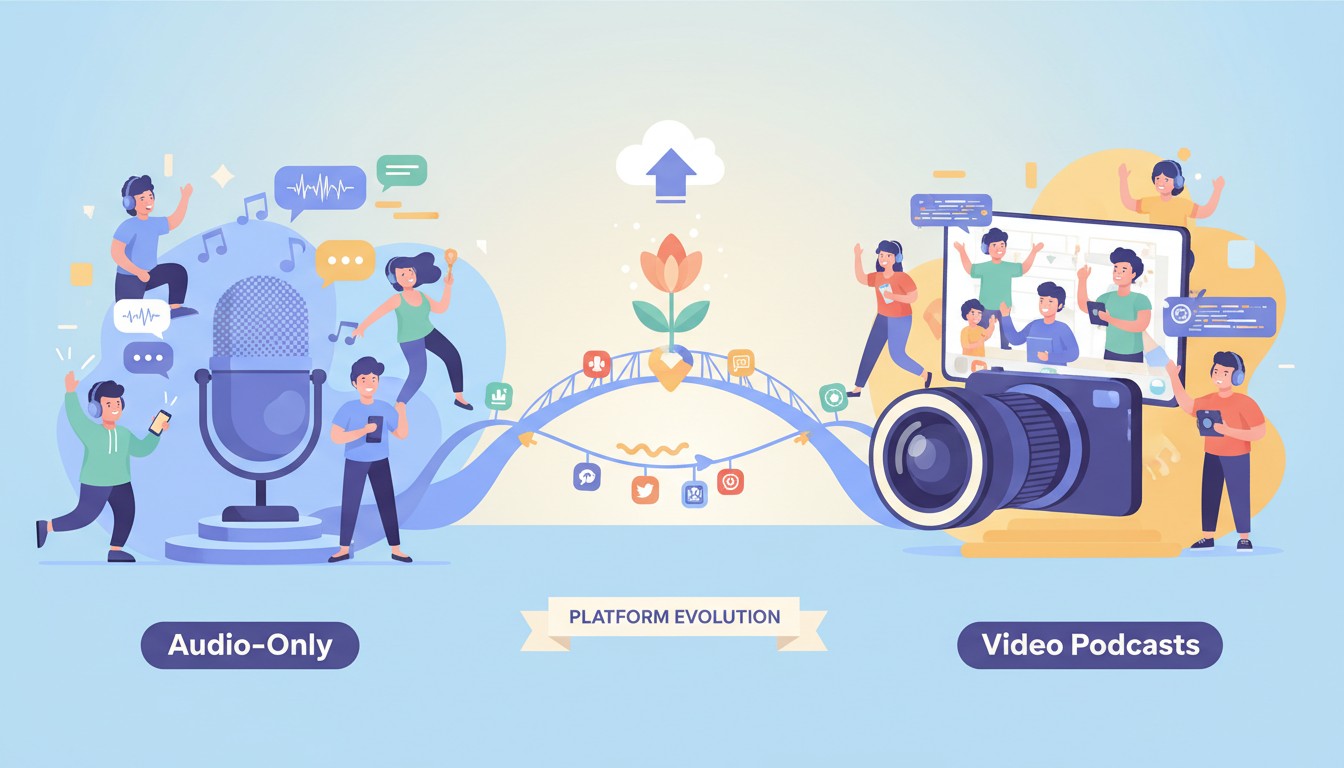
The podcasting world is fracturing along a sharp divide: video-first creators feeding YouTube’s discovery engine versus audio-only purists clinging to the medium’s intimate roots. Platform evolution has turned a creative choice into a strategic necessity, as algorithms, monetization structures, and audience discovery mechanisms diverge so completely that choosing a format now means choosing an entirely different business model.
This isn’t about preference anymore—it’s about survival. Video podcasting requires at least triple the production investment in equipment, time, and skill, yet delivers 2.3x higher audience growth rates. Audio-only shows maintain superior completion rates—80% versus video’s 20-30%—but struggle with discoverability in a visual-first platform ecosystem. Creators are being forced to either scale up resources they don’t have or watch their organic reach vanish.
The Platform Pivot: How Algorithms Are Forcing Hands
The format war didn’t start with creators—it started with platforms making strategic bets on video. YouTube, having conquered traditional video, set its sights on podcasting as its next growth vector. Its algorithm now aggressively promotes video podcasts, offering superior search capabilities, automated recommendations, and monetization through both AdSense and creator programs that audio-only platforms can’t match.
Spotify responded by making video a core part of its podcasting strategy, pushing creators to upload visual versions or risk lower placement in recommendations. Riverside’s research shows video podcasts generate “significantly more streamlined opportunities for monetization” through multiple revenue streams that audio can’t access. The platforms aren’t neutral—they’re combatants, and creators are the collateral damage.
The Algorithmic Bias
Audio-only podcasts suffer from a fundamental discoverability problem: podcast apps aren’t algorithm-based. As Brianna Ansaldo notes, “It’s becoming increasingly rare that someone goes to their favourite podcast app, types in a search keyword and your show appears”. Traditional podcast search is keyword-matching, not behavior-predicting.
YouTube’s algorithm, by contrast, learns what you like and serves it proactively. It recommends video podcasts based on watch history, creates personalized playlists, and surfaces content through related videos. This creates a self-reinforcing loop: video podcasts get more views, which triggers more recommendations, which creates more growth. Audio-only creators are left shouting into a void where the only discovery mechanism is word-of-mouth or paid promotion.
The Resource Reality Check: Cost vs. Reward
The format war’s cruelest irony is that it punishes the very simplicity that made podcasting democratic. Audio-only podcasting is cheaper, faster, and simpler. You need a quality microphone and basic editing software—you can record in your bed looking like a mess and no one knows. The intimacy of audio allows authentic connection without visual perfection.
Video podcasting is exponentially more complex. You’re dealing with professional lighting setups, set design, multiple camera angles, and significantly more post-production. While video outperforms across most metrics, it costs 77% more per hour of audience attention to produce. For independent creators without production budgets, this isn’t a choice—it’s a ceiling.
Production Cost Comparison
Audio-Only Setup: $300-500 (microphone, boom arm, basic software)
Video Setup: $2,000-5,000+ (cameras, lighting, set design, editing software, graphics)
Time Investment per Episode: Audio 3-4 hours | Video 8-12 hours
Skill Requirements: Audio (recording + editing) | Video (filming + lighting + visual editing + thumbnail design)
ROI Timeline: Audio breaks even in 6-12 months | Video typically 18-24 months
The Consumation Paradox: Attention vs. Connection
Here’s where the format war gets contradictory. Video podcasts drive higher discoverability and broader reach, but audio-only shows generate deeper connections and better retention. Audio consumption rates hover around 80%—meaning listeners finish most episodes—while video podcasts battle constant distractions, achieving only 20-30% completion.
This creates a strategic nightmare for creators. Do you optimize for algorithms and impressions (video) or for loyalty and trust (audio)? The former builds a wide but shallow audience; the latter builds a narrow but devoted one. Sponsors increasingly demand both—wide reach for brand awareness, high engagement for conversions—forcing creators into a hybrid model they may not have resources to sustain.
The Gen Z Curveball
Platform assumptions about video preference face a surprising challenge from the very demographic driving digital trends. A new study shows Gen Z still favors audio-only formats over video when consuming podcasts, defying the conventional wisdom that younger audiences demand visual stimulation.
This suggests the platform push toward video may be misaligned with actual audience preferences. Gen Z uses podcasts specifically for multitasking—listening while gaming, studying, or commuting—contexts where video is disruptive. They’re not rejecting video entirely; they’re choosing audio strategically for specific content types. The platform’s one-size-fits-all video mandate may be solving a discoverability problem while creating a consumption problem.
The Format Fragmentation: Two Mediums, Two Churches
Perhaps the most significant evolution is that video isn’t just changing podcasting—it’s creating a separate medium entirely. Solo shows are more popular among audio-only creators, while interview formats dominate video. The production values, audience expectations, and monetization strategies have diverged so completely that we’re witnessing the birth of “video podcasts” as distinct from “audio podcasts with video versions.”
This fragmentation creates strategic challenges for creators. A show designed for audio intimacy—raw, vulnerable, conversational—often feels awkward and under-produced when video is added. Conversely, a show optimized for video—visually dynamic, tightly edited, thumbnail-friendly—can feel overproduced and insincere as pure audio. Format misalignment risks alienating both audiences rather than capturing both.
Real-World Impact: Platform Data Reveals the Split
The format war isn’t theoretical—it’s reshaping platform dominance. As of September 2025, Apple Podcasts commands 37% of listeners and Spotify 32% for audio-only, a duopoly built on RSS feeds and traditional distribution. But for video podcasts, YouTube has become the undisputed king, with many creators reporting 3-5x the views on YouTube compared to audio downloads.
This split creates a strategic nightmare for creators. If you go audio-only, you lock yourself into Apple’s stagnant discovery ecosystem. If you go video-first, you’re competing with the entire YouTube content universe, where a podcast episode battles cat videos and vloggers for attention. The ROI calculation becomes maddening: video outperforms but costs 77% more per hour of actual audience attention, while audio delivers better engagement but can’t break through the discoverability wall.
The Monetization Mirage
Video podcasts promise multiple revenue streams—AdSense, creator programs, influencer deals, sponsorships—but the competition is brutal. Audio podcasts maintain higher CPM rates for host-read ads because the intimate format drives better conversion. YouTube’s creator programs are lucrative, but require massive scale to generate meaningful income. For mid-tier creators (5K-50K downloads/episode), audio sponsorships often deliver more predictable revenue than video’s hit-or-miss algorithmic payouts.
The real monetization winner? The platforms themselves. YouTube captures 45% of ad revenue while providing the infrastructure. Spotify pays minimum guarantees to exclusive shows but takes a cut of all ads. Apple sells subscriptions but offers no discovery. In the format war, creators fight each other while platforms collect the spoils.
The Hybrid Compromise: Can You Serve Two Masters?
Faced with an impossible choice, many creators attempt a hybrid approach: record video, extract audio for podcast feeds, and hope to capture both audiences. This seems logical but creates new problems. The production must satisfy video’s visual demands while maintaining audio’s conversational flow—a balance that’s harder than it appears.
Brianna Ansaldo recommends starting with audio excellence, then gradually integrating video as resources grow. This approach allows testing video elements (short clips for social) without full commitment. For established shows, video becomes a growth accelerator—if quality standards can be maintained.
But the hybrid model also doubles workload. One episode becomes multiple deliverables: a full video for YouTube, an audio edit for podcasts, short vertical clips for TikTok, thumbnail graphics, and SEO-optimized descriptions. What was once a focused creative act becomes a content atomization factory, draining the spontaneity that made podcasting authentic.
The Strategic Choice: Resources, Content, and Growth
The format war ultimately forces creators to make three honest assessments:
1. Resource Reality
Can you realistically invest 3x more time and 5x more money for uncertain returns? Video only pays off if you can maintain high production value. Low-quality video damages your brand more than polished audio builds it. Many creators discover too late that they’ve scaled production without scaling audience, ending up with expensive content that performs worse than their simpler audio shows.
2. Content Compatibility
Does your content actually benefit from video? Interview shows gain from body language and visual chemistry. Educational content profits from demonstrations. But narrative storytelling, vulnerable monologues, or conceptual deep dives often lose power when visual distractions compete with imagination. Ansaldo notes that vulnerability feels more genuine in audio, where listeners project their own emotions onto your voice.
3. Growth Strategy Alignment
Are you building a personal brand that needs face recognition, or delivering valuable content that stands alone? Video accelerates personal branding through visual recognition, but audio builds deeper trust through sustained intimate contact. Video offers microcontent opportunities—one episode becomes dozens of clips—while audio offers focused impact. Your growth strategy must match your format.
The Decision Matrix
Choose Audio-Only If: You have limited budget, value deep listener connection, create narrative/vulnerable content, and prioritize sustainable production over rapid growth.
Choose Video-First If: You have production resources, need discoverability, create educational/interview content, and are building a visual personal brand.
Choose Hybrid If: You can afford incremental scaling, want to test both audiences, and have content flexible enough to work in both contexts.
The Platform Evolution: Where We’re Actually Headed
The format war won’t end with one side declaring victory. Instead, we’re seeing platform specialization. YouTube will become the default home for video podcasts, using its search and recommendation muscle to dominate discovery. Spotify and Apple will maintain audio loyalty among commuters and multitaskers. The middle ground—creators trying to serve both—will become increasingly unsustainable.
This evolution actually serves listeners better, as platforms optimize for specific consumption patterns rather than forcing one format into every context. The fragmentation creates clearer paths for creators: choose your platform based on your content, not the other way around. The “right” format isn’t universal—it’s specific to your audience, resources, and voice.
The real danger isn’t video or audio winning—it’s creators bankrupting themselves trying to serve both. Listener preferences remain split, with many preferring audio for its intimacy and convenience. The platforms’ push toward video is about their business models, not necessarily audience desires.
The Format War Is a False Choice
The real divide isn’t between video and audio—it’s between content created for platforms and content created for people. The platforms will always want more: more visual elements, more algorithm-friendly metadata, more content to fill their feeds. But audiences want what they’ve always wanted: authenticity, value, and connection.
You don’t win the format war by picking the “right” side. You win by refusing to let platforms dictate your creative choices. Choose the format that serves your content, respects your resources, and honors your audience’s actual needs—not the format that algorithms temporarily favor.
The future of podcasting isn’t video-only or audio-only. It’s creators who know their voice, understand their audience, and pick platforms strategically rather than desperately. Your format isn’t a limitation—it’s a choice about what kind of relationship you want to build with the people who choose to listen to you.
Key Takeaways
Platform algorithms actively push video podcasts for business reasons, creating a discoverability crisis for audio-only creators who rely on traditional RSS-based distribution.
Video podcasting costs 3-5x more in time and money to produce but delivers 2.3x higher growth rates, forcing creators into an unsustainable ROI calculation.
Audio maintains superior completion rates (80% vs 20-30%) and deeper listener connection, while video offers better searchability and monetization options.
Contrary to platform assumptions, Gen Z—the demographic driving digital trends—still prefers audio-only podcasts for multitasking and intimacy.
The “format war” is best navigated by choosing the medium that serves your content type, respects your resources, and builds the audience relationship you value—rather than reacting to platform pressures.